Cannabis and Post-Traumatic Stress Disorder

cannabis

Twenty-three states have legalized the use of cannabis for those who suffer from medical conditions like arthritis, migraines, AIDS, cancer, and psychiatric illnesses. Yes, even post-traumatic stress disorder makes the list, which means, if you are among the 7.7 million people who suffer from symptoms, you’re in luck. It appears that scientists agree cannabis may be just what you need to alleviate your anxiety related to PTSD. Researchers at NYU Langone Medical Center have found a connection between the human brain’s cannabinoid receptors, called CB1, and PTSD. These receptors are linked to an intricate internal engine of chemicals and neurological pathways called the endocannabinoid system, which affects our emotions, appetite, pain tolerance, and memory. Studies have been conducted on animals, showing that cannabis, together with naturally occurring chemicals in the body, stimulate CB1 receptors and interfere with memory.

Physicians at the NYU School of Medicine conducted brain scans on people with PTSD and found that they had lower levels of a certain endocannabinoid than those without PTSD. With this knowledge, not only can they better diagnose individuals with PTSD, they can treat them with a something that works, rather than antidepressants, which don’t always work. Studies have shown that those who take antidepressants continue to suffer from nightmares, flashbacks, night sweats, and poor sleep. But those who were administered a synthetic form of cannabis experienced significantly less intense nightmares, or no further nightmares at all. http://www.newswise.com/articles/brain-imaging-study-links-cannabinoid-receptors-to-post-traumatic-stress-disorder-findings-bring-first-pharmaceutical-treatment-for-ptsd-within-reach http://onlinelibrary.wiley.com/doi/10.1111/j.1755-5949.2008.00071.x/full

So, for those of you who are looking for an alternative to Paxil, Zoloft, Prozac, or any of the other alphabet soup of drugs on the market that claim to create a Zen-balance among the sea of moody chemicals sloshing around in your brain, science is on your side. And there’s good news for those living in Connecticut, Delaware, Maine, New Mexico, Oregon, Nevada, or Michigan – they allow the use of cannabis to help alleviate PTSD symptoms. Arizona recently authorized the use of cannabis use for PTSD – the provision goes into effect January 1, 2015. http://www.azcentral.com/story/news/arizona/politics/2014/07/09/medical-marijuana-can-treat-ptsd-arizona-official-decides/12418673/

Each state’s guidelines are different, but here’s the basic rub: You need to have documentation from a “certifying” physician who can attest that you suffer from “debilitating” symptoms that interfere with your ability to carry out “activities of daily living.” http://medicalmarijuana.procon.org/view.resource.php?resourceID=000881

Read More
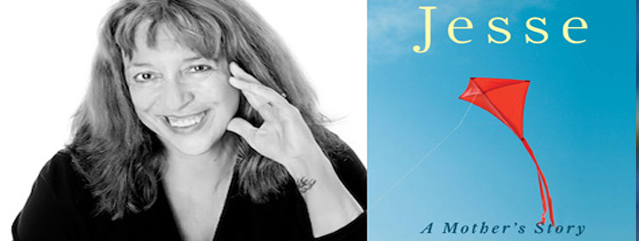

Review of Marianne Leone’s Memoir Jessie

Jesse

Born ten weeks premature, Jesse Cooper suffered a brain hemorrhage, and survived – with cerebral palsy. In 2005, at age seventeen, he died.

During the course of my twenty-year career as a pediatric and neonatal intensive care nurse, I cared for thousands of babies and children, many who had cerebral palsy. I provided the best care possible – heeded their cries, exercised their rigid limbs, and carefully fed them pureed foods so they wouldn’t choke. But it was impossible for me to know what it was like to be a mother of a child with cerebral palsy, or any of the ill children I cared for.

But actress Marianne Leone knows. In her memoir, Jesse, Leone writes with stark prose, sharing with us her “mask of red rage,” and her “fuck-you double slather of red lipstick,” as she, and her actor-husband Chris Cooper, work tirelessly to navigate the hairpin turns of their lives caring for a child with cerebral palsy (185, 189). She lures us along in their trek, from Jesse’s endless days in the neonatal intensive care unit, through their frustrating odyssey in search of physical, occupational, and speech therapists who would treat Jesse with dignity, and their fevered commitment to convince the school system within their community to integrate Jesse into classes with what Leone calls “able-bodied” students. Leone reminds us that “Jessie wasn’t a CP kid first, and a kid second (57).”

Jesse is more than a mere telling of the speed bumps Leone and her family encountered along the way. It is a story of perseverance, and idiosyncratic family coping mechanisms in the face of Sisyphean challenges. It hurtles the reader into a better awareness of what it means to be a quadriplegic, and non-verbal – which does not equate with being an “idiot (31).” Leone’s memoir is a must-read for families, health care professionals, teachers – all of us – who are on a quest to do what is right for our children, whether or not they are disabled.

Jesse speaks to the human condition – in this case, internal conflict – and the human being in us: Even long after the death of her son, Leone admits she’d rather “stay inside and be alone (248).” But she also knows, in order to still feel connected with her son, she must reach out and talk to other mothers with “babies like Jesse (248).”

Jesse himself tugs at the human being in us. His humor, non-judgmental approach to others, and endurance – he was an honor roll student, and windsurfed and wrote poetry – impels us to take a long, hard look at ourselves and ask, “Who am I? Am I aware of what is happening around me? How do I treat others? How do I want to be treated? What meaningful contributions am I making to others? What if I were a quadriplegic and non-verbal?”

In an autobiography Jesse wrote in sixth grade, he says:

“The most important lesson I can teach/is to see people for what they can do/ and not for what they cannot do (82).”

Read More

Nurses and Ebola

nurses_ebola Associated Press Photo


Though the latest Ebola outbreak is mostly confined to three West African countries, three cases – two of them nurses who cared for a patient from Liberia with the virus – have been confirmed in the United States. That pales in comparison to the number of people who have died from the virus in West Africa – 4,484 as of October 18. With such knowledge, we have little reason to panic. And, with the influenza season at our heels, we have larger concerns to contend with: two hundred thousand people are hospitalized every year from the flu, and between 3,000 and 49,000 people die.
http://www.cdc.gov/vhf/ebola/outbreaks/2014-west-africa/case-counts.html

http://www.cdc.gov/flu/keyfacts.htm

But it makes sense that nurses in the US are vocalizing their concerns about the Ebola virus and lack of adequate personal protective equipment. Among the 18 million health care workers employed in the United States, registered nurses comprise nearly 3 million. Nurses are the primary caregivers of hospitalized patients. http://www.cdc.gov/niosh/topics/healthcare http://www.aacn.nche.edu/media-relations/fact-sheets/nursing-fact-sheet

According to the CDC, the “natural reservoir” of Ebola has yet to be identified, so the process of a human being infected is not known. But researchers believe the “first patient becomes infected through contact from an infected animal.” Ebola is spread through direct contact with body fluids, such as blood, vomit, semen, feces, and breast milk, as well as contaminated needles, and infected mammals – i.e. humans. Insects cannot contract the virus.
http://www.cdc.gov/vhf/ebola/transmission/index.html?s_cid=cs_3923

Since nurses, and other health care workers, are exposed to all kinds of body fluids, they are at the highest risk of getting sick when caring for patients with Ebola. If nurses become ill from the virus, who will care for the millions of patients who are hospitalized every year for various other illnesses? The CDC recommends the following personal protective equipment (PPE): disposable gloves, gowns, goggles, and a face mask in the event body fluids splatter. In cases where there is a large amount of body fluids, double gloving, booties, and leg coverings may be required.
http://www.cdc.gov/vhf/ebola/hcp/patient-management-us-hospitals.html

But is this enough? The typical hospital gown is made of cotton material, easy for fluids to seep through. Perhaps double gowning is a good idea, but what if your hospital unit runs out of gowns?

The nurses who cared for the dying patient in Dallas wore full PPE, including Tyvek suits – heavy-duty outfits that look like space suits – and a face shield and respirator mask. They even wore three pairs of gloves and booties. Yet, they became infected. Because the suits were too large, and exposed the necks of the nurses, the CDC recommended they secure the neck of the gowns with tape.
http://bigstory.ap.org/article/f5d8d9bb2f2a44d59dd10042d3e0e57b/existing-protocols-might-not-be-enough-ebola

National Nurses United, the largest union of registered nurses, has reached out to hospitals, advocating for better PPE, training on how to properly use the equipment, and adequate staffing to appropriately care for Ebola patients.
http://www.nationalnursesunited.org/pages/nursing-practice-patient-advocacy-alert-treatment-of-patients-with-ebola

What is your hospital doing to protect your nurses, and patients?

For more information on the CDC’s most recent guidelines when caring for Ebola patients go to:
http://www.cdc.gov/media/releases/2014/fs1020-ebola-personal-protective-equipment.html

Read More

How to Change Fiddle Strings

How_to_Change_-fiddle_-stings

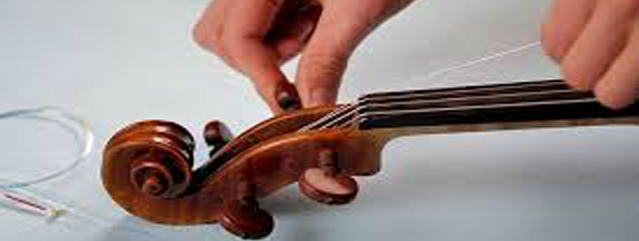
The first time I changed the strings on my fiddle, I started by removing all four of the old ones at the same time, thinking that would be a good time to give my fiddle a thorough dusting. But what I hadn’t considered was the sound-post, until it collapsed after I removed the strings (fortunately, it did not slip into one of the F-holes – the long, curlicue-like openings in the top of the fiddle). That’s why it’s strongly advised to change one string at a time. Which string to start with is not critical, but most fiddlers prefer to start with the G-string (I start with the E string, because that’s what my fiddle instructor taught me after I confessed to her my oversight). You never know when a string will pop out of its slot and break, so it’s a good idea to have an extra set of strings in your case. Hope this helps.

For steps on how to change fiddle strings, go to: http://www.violinonline.com/changingstrings.htm

Read More

Newborns Do Feel Pain

Newborns_do_feel_-pain

Luis Grenada, a 16th century theologian, would probably not care whether or not newborns feel pain, for he called them “a lower animal in human form.” And during the early 20th century, the ignorance of the times drove researchers to stick newborns with pins, even while they were asleep, to determine whether or not they sensed pain. Their defensive frantic kicking apparently was not adequate proof. More studies were undertaken, more pinpricks. Because the newborns reacted with what one researcher called “diffuse bodily movements accompanied by crying,” she determined that they had “limited sensitivity to pain” (http://www.nocirc.org/symposia/second/chamberlain.html). But did these researchers take into consideration that mothers might have received anesthesia during labor, effecting newborns’ response to painful stimuli?

A 2011 British study concluded that the sensation of pain starts before birth, between 35 and 37 weeks gestation (http://www.livescience.com/15975-babies-feeling-pain.html). Continually sticking newborns with pins merely to prove they  feel pain is unnecessary, and cruel. As a neonatal intensive care nurse, my job, unfortunately, required me to poke babies’ heels for blood samples – I don’t need to share with you the more than unpleasant experiences.

Newborns may experience pain from surgery, and discomfort from the various tubes inserted into their bodies. Male newborns undoubtedly feel pain when circumcised. Dozens of studies, in which researchers have measured cortisol levels in babies, have proven so. They noted that this stress hormone increased as high as four times the levels prior to circumcisions (http://www.circumcision.org/response.htm).

So, if you’re a novice neonatal nurse, or a first time parent, here’s clear evidence that a newborn is experiencing pain:

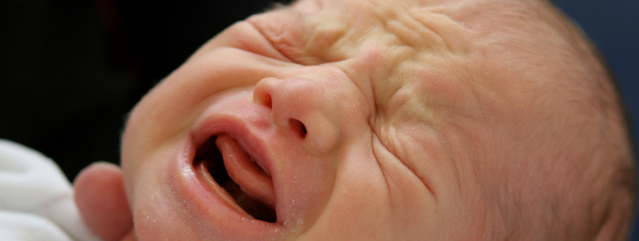
Crying: At one time, people believed newborn cries were not purposeful sounds, but random noises. But when a newborn cries, I mean wails, his breath cut short, his face turning the color of an eggplant, you know he needs more than his diaper changed. With prolonged crying, newborns may turn cyanotic, or blue, from decreased oxygen levels.

Facial expressions: furrowed eyebrows with eyes squeezed shut. You might also notice their chins quivering.

Body Language: Kicking. Clenched fists. Flailing – arms and legs pulled in then stretched out. Premature babies often become quite and still, or floppy when in pain.

Vital signs: Increased heart rate and blood pressure. Decreased oxygen levels. A change in vital signs are particularly helpful when assessing premature or ill newborns in pain, as they do not have the energy to cry or flail like healthy newborns.

To help determine appropriate intervention, it’s common practice for nurses to score newborns’ discomfort (http://www.vuneo.org/nppainass.htm).

But how do you relieve newborns’ pain? If you’re a neonatal nurse, and the source of pain is evident – the newborn just woke up from abdominal surgery for instance – administration of narcotics might be warranted. Parents might worry that their newborns will become addicted to pain medication, but allowing babies to endure unnecessary pain comes with consequences: difficulty sleeping and eating, and physiological and structural changes in the nervous system. Babies might become hypersensitive to pain during future procedures (http://www.ncbi.nlm.nih.gov/pubmed/12391738). Different from addiction – a psychological issue – babies can become physically dependent on pain medication. To avoid withdrawal symptoms, nurses slowly wean them off medication.

Swaddling, breastfeeding, skin-to-skin contact with parents, sucking on a pacifier, and infant massage can also alleviate newborn discomfort (http://www.parents.com/baby/care/newborn/how-to-massage-baby).


Read More
error

Enjoy this blog? Please spread the word!