Need Inspiration to Play the Fiddle?

inspiration_-to_-play_-fiddle

Do you need inspiration to play the fiddle (or any instrument)? I’ve been playing the fiddle off-and-on for more than ten years. I used to practice every day, for an hour, sometimes longer. I was obsessed with learning new tunes. But, because of other commitments, that changed. I’m embarrassed to admit how little I’ve practiced over the past few years. Okay, I’ll admit it: once a week, for thirty minutes. Playing the fiddle is not how I earn my living; it’s how I escape everyday stressors. I play because I enjoy it, and do perform in local coffee shops and for residents of assisted living facilities once in awhile. If you’re are interested in expertise then you might consider following the “10,000 hour rule,” that is if you believe in it. Similarly, if you’re a music student, or a performer, practicing once a week is not enough for the brain to learn new concepts, or to form muscle memory. If you play the fiddle for pure enjoyment, then in may not matter to you how often, and for how long, you practice. Some say that practicing for brief periods several days each week is better than practicing for long periods less frequently. Sessions may be as short as twenty minutes for children and as long as an hour for adults. Studies have shown that gains begin to decline after two hours of practice.

If you’re looking for inspiration to pick up your fiddle more often, here are some tips:

  • Leave your fiddle where you can see it
  • Listen to music you enjoy and are interested in learning to play
  • Join a music group, or attend sessions
  • Take lessons on a routine basis
  • Attend music camps
  • Set up a date with a friend who also plays an instrument and practice together – do this once a week, or every other week, as much as your schedule allows
  • Write down a reminder to practice in your date book
  • Set goals: “I’m going to learn tune X by the New Year”
  • Follow other musicians on social media for support and inspiration
  • Practice during a time of day when you are most alert and motivated

If you have other suggestions, please share!


Read More
How to Change Fiddle Strings

How_to_Change_-fiddle_-stings

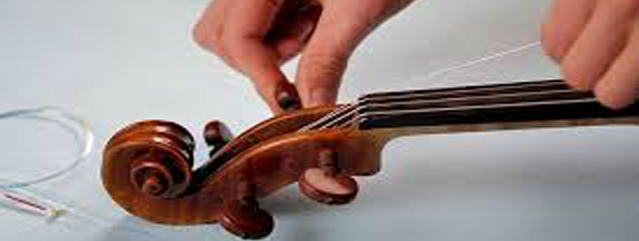
The first time I changed the strings on my fiddle, I started by removing all four of the old ones at the same time, thinking that would be a good time to give my fiddle a thorough dusting. But what I hadn’t considered was the sound-post, until it collapsed after I removed the strings (fortunately, it did not slip into one of the F-holes – the long, curlicue-like openings in the top of the fiddle). That’s why it’s strongly advised to change one string at a time. Which string to start with is not critical, but most fiddlers prefer to start with the G-string (I start with the E string, because that’s what my fiddle instructor taught me after I confessed to her my oversight). You never know when a string will pop out of its slot and break, so it’s a good idea to have an extra set of strings in your case. Hope this helps.

For steps on how to change fiddle strings, go to: http://www.violinonline.com/changingstrings.htm

Read More

Teaching Children to Play the Fiddle

teaching_children_-fiddle

Whenever I spent time with my three-year-old niece, she would bounce and clap to the Irish tunes I played for her on my fiddle (note: the fiddle and violin are the same instrument. The style of music differs: fiddlers typically play traditional music like old time, Celtic, and Klezmer, and violin players typically perform classical and jazz music. Since I play traditional music, I prefer the term fiddle). When I stopped playing, she’d yell, “Let me, let me play!” I certainly was not going to allow her, or any three-year-old, even touch my 1920’s one-of-a-kind fiddle. But she’d reach out for it, and try to yank on the neck of the instrument. I’d put it away, hide it in the closet, but she was developmentally on target and had a full understanding of object permanence. So she’d run to the closet, and attempt to pull the fiddle out of its case – but I knew enough to lock it. She’d follow me around the house, and do what a three-year-old does when she doesn’t get her way: jump up and down, cry, and scream, “Why not? Why not? “I want to play!”

I had never taught a child how to play the fiddle, but wanted my niece to learn. After all, learning an instrument improves academic skills in children, fosters their social skills, and helps them develop motor coordination. Learning an instrument, especially the fiddle, also teaches children how to be disciplined and patient. You don’t just pick up a fiddle and suddenly play a Bach concerto, unless you’re a Mozart musical prodigy.

So how do you teach a young child to play the fiddle? First, let’s start with when to begin teaching. Each child is unique in terms of her behavior and cognitive abilities. Some children are more cooperative than others, and can focus longer. A five-year-old might throw a tantrum when asked to sit for more than two minutes, whereas a three-year-old might be perfectly willing to sit for fifteen minutes as you hold the fiddle under her chin while she practices plucking the strings.

In The Strad, a magazine devoted to string instruments, Anne Bacon offers advice on how to approach a child’s first fiddle lesson. She reviews the proper fiddle hold, and how to teach children to handle the bow and pluck the strings. http://www.thestrad.com/latest/editorschoice/teaching-a-young-beginner-their-first-violin-lesson

On the website, Music in Practice, Sue Hunt, a teacher with 25 years of experience, offers tips on when to begin teaching your child the fiddle, and how to make the process fun and engaging. http://www.musicinpractice.com/2013/practicing-music-violin-lessons/

Other resources:

http://www.parents.com/kids/development/intellectual/benefits-of-music-lessons/

Read More