Benefits of Being a Military Nurse


military_nurses

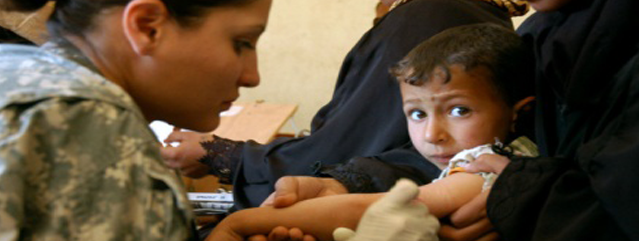
Are you interested in entering the nursing profession? If so, you could not have chosen a better time to do so. The fastest growing field in the United States is healthcare, with more than 3.5 million jobs projected to be added to the economy by 2020. One-third of that number will be registered nurses. If you are planning to go to nursing school, you may be interested in one of the more popular specialties: neonatal nursing, midwifery, or critical care. Or maybe you’re interested in military nursing. Nursing School Hub, a website dedicated to providing resources for those interested in the nursing profession, recently posted an info-graphic article, “The Military Nurse’s Toolkit.”

The benefits of being a military nurse may tempt you: loan repayment, world travel, and the opportunity to help a broad population. It goes without saying that military nurses face risks: physical injury by enemy combatants, and psychological stress from exposure to injured and deceased soldiers. If you have not read my post about PTSD and nurses, I encourage you to read it here.

If you are not interested in military nursing, but are eager to learn about nursing-related topics, such as scholarships, must read books for nurses, top nursing schools and jobs, and where to find a job, I recommend taking a good look at Nursing School Hub’s website.


Read More

Post-Traumatic Growth

In the wake of the Iraq and Afghanistan wars, we’ve learned more about post-traumatic stress disorder. But have you heard about post-traumatic growth (PTG)? Richard Tedeschi and Lawrence Calhoun, psychologists at the University of North Carolina in Charlotte, conceived the concept in the 1990s. PTG involves a positive psychological change that occurs after experiencing a traumatic event. PTG can be measured through what is called the PTG inventory. But each one of us copes differently, and who is likely to experience PTG depends on several factors, such as personality traits, mood, and gender. http://www.posttraumaticgrowth.com/what-is-ptg/

If you are interested in learning more about PTG, consider reading What Doesn’t Kill Us: A Guide to Overcoming Adversity and Moving Forward by Stephen Joseph: http://www.profstephenjoseph.com/

Here are some other resources that might be of interest:

Post-Traumatic Growth: Positive Changes in the Aftermath of Crisis. Richard Tedeschi, Crystal Park, Lawrence Calhoun. March 1998.

Super Survivors: The Surprising Link Between Suffering and Success. David B Feldman and Lee Daniel Kravetz. June 2014.

American Psychological Association: www.apa.org/post traumatic growth

Read More

Post-Traumatic Stress Disorder Linked to Premature Births

In 2012, nearly half a million premature births occurred in the United States. An infant born before 37 weeks gestation is considered premature. Risk factors include: race, smoking, alcohol use, having delivered a previous pre-term infant, carrying multiple infants (twins, triplets), problems with the uterus or cervix, and chronic illnesses such as diabetes, asthma and kidney disease. www.cdc.gov/PrematureBirth

If you don’t already know, post-traumatic stress disorder is also considered a risk factor for premature births. In the largest study ever conducted, researchers at Stanford University Medical Center followed more than 16,000 infants delivered by female veterans. More than 3,000 premature births were delivered by mothers diagnosed with PTSD. Those diagnosed with PTSD in the year prior to delivery were found to be at thirty-five percent greater risk. The researchers factored in other issues, such as race, age, medical conditions, and alcohol and drug use. It’s worth noting that fifty percent of the women studied never went into combat, proving that the link between PTSD and delivering a premature infant is not exclusive to veterans. Civilian women are affected too. www.sciencedaily.com/2014/11/14

But how does PTSD contribute to premature births? Stress. Though the exact mechanism is not completely understood, higher than normal levels of stress hormones are released in those suffering from PTSD symptoms. The immune system then becomes suppressed, increasing the risk for infection, which increases the risk for premature birth. www.marchofdimes.org/pregnancy/stress

The good news: those who do not experience PTSD symptoms in the year before delivery are at the same risk for giving birth to a premature infant as those who do not have PTSD. For those who do suffer symptoms in the year prior to delivery, treatment is available. The Veterans Administration is using the results of the study in the care of pregnant women with PTSD. For pregnant civilians with PTSD, the good news is that you now know you are at risk, and can inform your obstetrician. There are some risk factors you might not be able to control – age and race for instance – but you can gain control over your PTSD. www.sciencedaily.com/2014/11/14

For a list of therapists, go to The National Board of Certified Counselors at: www.nbcc.org/counselorFind

Read More

How Yoga Helps Heal Post-Traumatic Stress Disorder

downward_dog

What is your New Year’s Resolution? Perhaps it’s to eat healthier, exercise more, quite smoking. Maybe you have decided to take up yoga. If you suffer from symptoms of post-traumatic stress disorder, yoga just might be the perfect resolution. Studies show that yoga, specifically the breathing-based aspect, improves PTSD recovery. Hyper-arousal, nightmares, anxiety, difficulty sleeping, irritability, are all common features of PTSD. Yoga, which dates back to 3,000 B.C and practiced among warriors before heading into battle, means “to unite.” In other words, it helps us become more self-aware, allowing us to feel a sense of control over our own bodies. Yoga brings the mind and body back to a state of calm. http://www.traumacenter.org/research/yoga_study.php  http://uwire.com/2014/09/17/uw-study-finds-yoga-can-improve-ptsd-recovery/

Each morning (or most mornings), I sit cross-legged on my living room rug, take several deep breaths, then launch into ten minutes of yoga: downward dog, warrior I and II, Half Moon Pose, Plank, Forward Bend, Child’s Pose (not necessarily in that order). Downward Dog is my favorite – letting my head hang, my calves and hamstrings stretching, releasing a nighttime’s worth of bad dreams.

I know I could benefit from longer sessions, so I think that’s what I’ll strive for in 2015 – to breathe deeper, unite my body and mind, and, as Certified Yoga instructor Robin Carnes says, “draw [my] attention inward, away from outside stressors.” http://www.huffingtonpost.com/arianna-huffington/military-yoga-treatment_b_2443317.html

What about you? How about joining me in a few downward dogs?

Here’s a link to get you started: https://yoga.com/poses

Read More

How to Write Your Way Out of Post-Traumatic Stress Disorder

writing_through_ptsd

More than six years after an older driver ran into me, causing multiple injuries including post-traumatic stress disorder, I decided I wanted to write a memoir about the tragedy and its aftermath. I wrote (actually I typed) nearly everyday. Essentially, I dumped my brain onto the page, ignoring the logical left side as I typed fast and furious without thinking about the structure of my story. Six months later, I had 365 pages of facts muddled with emotion. Though I felt proud of myself for my accomplishment, a puddle of grief muddied the moment. I thought I was ready to write about the accident, but maybe I wasn’t. Maybe I hadn’t yet figured out how to navigate my PTSD speed bumps. As the months and years passed, I read the pages again and again, examined with a closer eye what I had written, pondered the subterranean meaning of each passage and turn of phrase. The combination of time, taking breaks from my story, and reuniting with it from the perspective of a maturing writer, helped me gain insight into my work. In essence, I had stepped outside of myself, outside of my PTSD, and looked at the endless pages from a different, non-PTSD angle.

I’m glad I stuck with writing because research shows that it helps heal PTSD, even brief periods of putting pen to paper. http://www.sciencedirect.com/science/article/pii/S0005796712001088

When we experience a trauma, physical and/or emotional, our brains work overtime to process it, interfering with our ability to be present for others, and ourselves. Writing our thoughts down helps to release the emotional burden, and helps us to organize, put our thoughts in order – clean up our metaphorical cluttered homes. Writing has been shown to benefit the immune system, and overall health. But a professor of psychology at the University of Texas in Austin, Dr. James Pennebaker, cautions: “Standing back every now and then and evaluating where you are in life is really important.” Speaking from experience, I agree.  https://www.utexas.edu/features/2005/writing/

So, where to start? Here are my ideas:

1) Journaling: Even if you jot down one sentence each day.

2) Carry a pad of paper with you at all times – when a disturbing thought crowds your brain, write it down.

3) In first person (from the perspective of “I”), write about an emotional, or traumatic, event that has kept you awake at night. Just write. Don’t think about who might see it – lock it in a safe deposit box if you have to. The rub: put it away for a month, or two, or three, and then go back to it.

4) Take the same piece you worked on in number three, and write it from a different point of view – second or third person – forcing yourself to step outside of your hypersensitive skin (I’ve engaged in this exercise – it opened a vault door I never knew existed).

Feel free to share how this exercises worked for you?

“There is no greater agony than bearing an untold story inside you.”  Maya Angelou, I Know Why the Caged Bird Sings


Additional Resource:

http://healmyptsd.com/2014/08/writing-for-ptsd-healing.html


Read More
error

Enjoy this blog? Please spread the word!