Pearl of Wisdom for Writers

As a writer, the hardest part for me is getting the words on the page, meaning this: my brain manages to arrange precisely what it is I want to write, but once I sit my butt in the chair, and face the screen, my brain slams its door shut. If only I had the key to that door, quick access to the words so beautifully aligned in my head. But, alas, I do not have such a key. Instead, I keep at it, and sometimes find myself sitting in front of the computer for an hour before coming up with a sentence I’m half-willing to share with the world.

Herein lies the problem: I fret way too much over every single word I write. I worry too much about what others will think of me and my writing once they read my work. Sure, there are days when my fingers dance a smooth Rumba across the keyboard, but those days are few and far between. What do I do about this? While it would be nice if I did have a key for the times my brain locks me out, I might lose it. Then what? What I need to do is build my own door, open it up all the way, and invite into my writing home whatever comes my way. What I need to do is loosen up a little more, to be a little more brave, a little more willing to do a Rumba.

If I’ve learned from anyone what it takes to do the narrative dance with abandon, it’s my brother-in-law Chris. Though he’s not a writer, he does know how to let go and be himself. What I admire the most about him is his so-what? attitude. He doesn’t empty his mental gas tank worrying about what others might think of him when he shares what he needs to share in the moment. In other words, he is as authentic as authentic gets. As long as I’ve known him (15 years), he has spoken his emotional truth, and has blown me away with how easily and calmly he speaks about all things real and human without censorship or self-judgement.

Because Chris is a self-described non-writer, and usually prefers to engage in live discussions with people, rather than texting, emailing, or sending letters, I was shocked and delighted when he texted his siblings and other close family a brief synopsis of his experience during his recent road-trip from Vermont to Florida. (For context: Chris was his mother’s caregiver for nearly two years, the reason why he did not hike the Appalachian Trail. She lived at OLP for a year, and passed away on November 21, 2018)

Let me write this down and share it, as time has a way of at least dulling my memories. On my adventure to Florida, I stopped at Johnson City, Tennessee. The next morning, I left and started south on Interstate 26. It’s difficult to describe on paper the majestic vistas I witnessed. The sheer power of the mountains as I traveled through the Smokies, Cherokee National Park, and the Appalachia Trail. I could not help have thoughts of regretting my decision in 2016 to not hike the AT. All the things I could have seen and experienced danced through my head. Daydreaming was definitely prevalent, but reality set in and navigating Atlanta was on my mind. South of Atlanta my mind once again drifted, but this time it was filled with visions of Mom. I will only try to describe one of the many that popped into my mind that afternoon. I am sitting with Mom – the place could be in Florida or OLP (Our Lady of Providence Residential Care Facility). Mom is eating a cookie, or could be candy, or ice-cream, that part doesn’t matter. I am cooking Mom some fish and a veggie. I mention to Mom to save room for dinner as she takes another bite of her goody of the day. Mom looks at me and tells me that she’s not hungry. I say nothing as she looks at me, daring me to contradict her. When I say nothing, she goes back to what she was doing, but I can’t help seeing an impish little smile that tells me she has won again, and is still in control. That night, as I fell asleep, my only thought was that I have no regrets. Majestic Mom and the real memories outweigh the majestic mountains and the wannabe memories. This will the last time I write something like this.

During a recent family gathering, I asked Chris what he meant by the last sentence in his text. To be honest, I was afraid of what he might say. You see, Chris has stage 4 lung cancer, and anytime he mentions the word “last” my overthinking brain raises its worry flag.

When he gave me a long goggle-eyed stare, I wanted to curl up and crawl inside myself.

Then he said, “Because it took me all day to write it. It was mentally exhausting.”

He smiled (thank goodness), which gave me permission to smile too, and we both nodded in agreement at one another.

But here’s the pearl of wisdom Chris so kindly offered, and which I quickly hung on a sturdy hook in my brain: “I wanted to write something during my trip,” he said, “but my head wasn’t in the mental space. Yesterday it was, so that’s when I wrote it.”

Because I’m a writer, I think I should write every day, seven days a week. But there are days when my “mental space” is closed, maybe because it’s out of town for a long-weekend, or it’s come down with a bad cold and needs a day or two on the couch, or maybe it simply needs a timeout. I think I just might do that: take a timeout the next time I’m sitting at the computer, and my brain slams its door on me. Yes, I think I will do that. And not regret it.

Chris’s cancer diagnosis has smacked him in the face with his own mortality, and it doesn’t take much to physically and mentally wear him down these days, but I know he has plenty of pearls left. And I can’t wait to open up his next serving of oysters.

Read More


Transportation for Seniors

transportation_services

I’m here to share with you my latest interview with ITNAmerica, a nonprofit transportation network for seniors serving fifteen states. “Why the interview?” you might be wondering. Have you ever thought about how you would manage your day-to-day life if you couldn’t drive? Do you ever think about what you’ll do when you’re old and frail, or old and ill, and can’t drive? While I don’t lose sleep over it, I do think about it. I think about how I’ll get to the grocery store, the bank, the movies, and, of course, the wine outlet. The answer: because my immediate world has left me with few emergency exists through which I can escape such dread-filled questions.

My eighty-eight-year-old mother-in-law, who lives in a condo down the hall from my husband and me, is blind in one eye and has dementia. She cannot driven; by choice she has not driven for years (God bless her), and depends on family for transportation. Fortunately, or unfortunately, depending on how you look at it, she prefers not to leave the house very much. When my father was diagnosed with Alzheimer’s, and the dents and scratches scarring the front and rear of his car left me no other choice but to take the keys away from him, he had to learn to accept that caregivers would be driving him to and from the bank, doctor’s appointments, and his favorite Italian restaurant. And because it was an older driver who slammed into me, and seveny-two others, while I was visiting a farmers’ market in California years ago, I can’t help imagine how all seventy-three of our lives would be much different if the driver had access to transportation services, and was willing to use them.

I learned about ITNAmerica while researching news articles for a writing project and, ironically enough, learned that the founder, Katherine Freund, experienced a similar tragedy to mine and dozens of others: In 1988, an eighty-four-year-old driver ran down her three-year-old son. He survived, but suffered a traumatic brain injury. Instead of letting herself get swallowed-up by anger, Katherine, an inspirational speaker who has been featured in The Wall Street Journal and on CNN, and has won numerous awards recognizing her work around public health initiatives, made lemonade out of lemons (forgive me for the cliched proverbial phrase). She built and supported community-based senior transportation services.

Like Katherine, I too feel summoned to advocate for the most efficient and cost effective transportation options for the older population. While here in Northern Vermont we have Neighbor Rides and Special Services Transportation Agency (SSTA), I’m not sure that’s enough. After all, an estimated 25% of Vermonters will be sixty-five and older by 2030. Believe it or not, Vermont ranks higher than Florida when it comes to age: 42.8 versus 41.9.

What transportation options for elders are available in your community? Maybe you’re twenty-nine, thirty-three, or fifty, like me, and saying this to yourself: it’s too soon to plan for when I’m eighty, eighty-nine, one hundred.

But I must agree with Jodi Picoult: “Time is an optical illusion- never quite as solid or strong as we think it is.”


Read More

March for Women, Compassion, Unity, Equality

yes_we_canThis past Saturday, at least fifteen thousand people marched through downtown Montpelier, Vermont, in the name of women’s rights, human rights, compassion, unity, and equality. I was among the thousands who sloshed through mud puddles and climbed over snow banks, each one of us determined to stamp out hatred and bigotry.

I’m not one for crowds, especially large crowds; if you have an anxiety disorder, like PTSD, you know what I mean. But I packed my Xanax – just in case – and drove the 40 miles with my step-daughter (thank you Rachel for being there with me) from Burlington to Montpelier, waited in five-miles of backed up traffic on the interstate before making an illegal U-turn (I can’t tell you how good it felt to break the law!) so we could exit onto an alternate route leading into town, then parked a mile from the state house. From there, Rachel and I took our first steps toward the center of inclusivity: the golden-domed state house.

Montpelier may be the smallest capital in the nation, but our voices here in Vermont are far from small. Yesterday, as we marched together, thousands waved signs reading, “Yes we still can … We should all be feminists … We the people … complacency is complicity.” We sang and chanted and shouted against oppression and injustice. We spoke out loud for what is right: helping the homeless and the poor, treating with dignity women, people of color, Hispanics, Jews, Muslims, gays, LGBQTs, the young and the old. And the disabled.

I give the disabled a sentence of its own, not because I believe they’re superior to others; I do so because I know too many disabled people, mostly those who have sustained traumatic brain injuries (TBI) and are now living with chronic side-effects, such as vision difficulties, chronic anxiety, sleep disorders, and rip-roaring headaches. Due to their injuries, some find it difficult to engage in substantial gainful activity, a social security disability insurance (SSDI) term meaning your medical condition prevents you from doing more than “insignificant” work. And if your disability prevents you from working twenty hours or more a week, the typical threshold for receiving employer-based benefits, this likely outcome is this: no health insurance. With the enactment of the Affordable Care Act, though, those with disabilities had options, and they didn’t have to worry about being discriminated against for having a pre-existing condition (a TBI for instance). The ACA offered increased accessibility to community health centers, and enacted a provision that axed annual and life time limits – a godsend for people with disabilities. For those who receive SSDI and Medicare under the program’s guidelines, they are (or should I say “were?”) protected.

But it’s 2017, and winter has arrived. “He who must not be named” plans to eviscerate the ACA, with no alternative other than the ambiguous executive order he signed just hour after he was inaugurated directing federal agencies to relieve individuals, state governments, businesses, and health insurance companies from “burdens” placed on them by the ACA.

Whatever that means? In the meantime, there are nearly 50 million people in the U.S. who have a disability, and about 8.8 million who receive SSDI benefits. Though “he who must not be named” promises Medicare for All, this is sheer talk from a man who, well, likes to talk. And, of course, “he” has to deal with the Republican controlled congress. What do the millions receiving Medicare under SSDI benefits – and those sixty-five and older – have to look forward to?

I wish I had a magic wand to make it all better, but I don’t. Yet, I do have my voice. I share my voice with you, sing and chant and cheer for you, keeping in mind the words that Martin Luther King Jr. spoke in 1965: “Our lives begin to end the day we become silent about the things that matter.”

The more we speak, the louder we speak, “about the things that matter,” the closer we come together, marching forward toward human progress and shaping a world in which every single one of us matters.


Read More

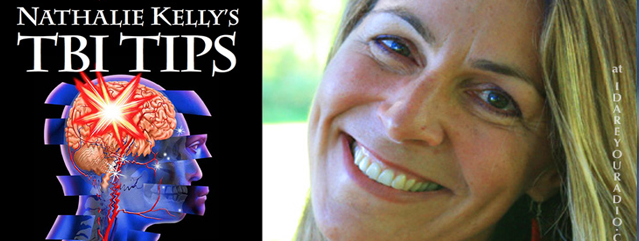
Meet Nathalie Kelly: Daring Dreamers Radio

Nathalie Kelly

What is it like to live with a traumatic brain injury (TBI)? Maybe you feel as if you know longer know who you are. You might say that your identity has been “stripped” away, that your independence has been ripped from you. You feel utterly lost. In an interview with marketing consultant Angela Treat Lyon on Daring Dreamers Radio, this is exactly how Nathalie Kelly, a TBI survivor, describes how she felt in the days, months, and years after her sailboat toppled over during a storm on Lake Champlain in Vermont and smacked her in the head, leaving her bobbing in the cold water for forty minutes, until the coast guard arrived.

A brain injury advocate, writer, inspirational speaker, and board certified hypnotherapist, Nathalie speaks with eloquence and candor about her post-TBI road-blocks, set-backs, growth-spurts, and more. The motto of Daring Dreamers Radio is “to dare you to live free, inspired, and in constant delight.” And that is precisely what Nathalie does in the interview: She has come to understand that living with a TBI means learning to accept that you are “perfectly imperfect,” and, though our culture frowns upon anything less than perfection, she “dares” us to embrace it, to “embrace vulnerability,” to let yourself be the person you are now, to shed all expectations of others. “That’s living an authentic life,” Nathalie says.

To be inspired and awakened and free, I dare you to listen to Nathalie’s interview at Daring Dreamers Radio.


Read More

National Novel Writing Month

nanowrimo

I wrote a novel in thirty days last November. Yes, you read that correctly. Thirty days. How did I do it? The drive to write, determination, and encouragement – from family, friends, and the staff at nanowrimo.

Nanowrimo, or National Novel Writing Month, begins every year on November 1, when participants begin working toward the goal of completing a fifty-thousand-word novel by midnight on November 30. Anyone can participate, from novice to veteran writers. All you need to do is sign up, create your novel on the website, and, of course, write at least sixteen hundred and sixty-seven words a day.

So what motivated me to spend a month doing little else but write? First, I already had an idea for a novel in mind, and had been thinking about starting it, but kept telling myself I’d get to it later, maybe next year. In September, two months before the kick-off of nanowrimo, my stepdaughter said, “Melissa, do it; you can do it.” Her enthusiasm was contagious. Why not? I thought – after spending the spring and summer revising my memoir, I had put it aside, with plans to read through and revise it, yet again, starting in December. So, what better time than November, when darkness presses down on the light, to push back against the sluggish side-effect of winter’s gloom, and write the first draft of my novel?

How did I begin? I began before the beginning – a lot of research, an outline, a diagram of the novel’s arc, flashcards jotted with brief descriptions of each chapter, character sketches – physical descriptors and clothing styles, family and work history, hobbies, dreams, favorite foods, habits, living situations, and strengths and weaknesses. I assigned each character a name that conjured his or her unique temperament, and downloaded from the Internet images that matched each character’s personality. I created living, breathing, heart-beating human beings, and listened to the nuances of each of their voices in my head. I moved into their lives, their minds, their every thought. I did all of this before typing word one.

Though I started preparing two months in advance of the kick-off of nanowrimo, and felt confident about the trajectory of my story, when I finally sat my butt in the chair to type the first sentence, the uninvited judge living in my head spoke mightily. And there were days when my brain churned on sloth speed and I struggled to reach the minimum daily goal of sixteen hundred and sixty-seven words. But I countered the judge’s arguments, re-filled my brain’s glucose tank with fun snacks (mostly dark chocolate), and gave myself pep talks: “Keep typing, keep writing, keep the characters alive and breathing.” Of course, there’s something to be said for seeing progress, in numbers. That’s partly how nanowrimo kept me going: Each day I downloaded what I had written on the website and, voilà, the link calculated exactly how many words I had written, how many words I had left to write, and my average word count per day. More than the word count, the unraveling of the story sustained me. By November 28, I had fifty thousand words. I was ahead of schedule! On November 30, I typed my last sentence. Total word count: fifty-three thousand nine hundred fifty-nine words.

Though it’s only January, and November is three seasons in the future, if you’re thinking about writing a novel, and want to sign up for nanowrimo next year, it’s not too soon to start thinking about your story now: plot, arc, theme, characters.  Though some people may have the brainpower and creative heft to dive into nanowrimo without a life jacket, I vote for having one nearby, whether it’s an outline, a diagram, or both. And getting your work onto the page will boost your confidence, deliver a lasting high, encourage you to say, “Yes, I can do it!”

Writing paraphernalia and conditions I recommend: Note cards, corkboard, your favorite pen, pencils, notebook, sticky notes, drawing paper, a quiet space, quotes from writers that inspire you, your favorite chocolates or other snacks, plenty of water, tea/coffee, comfy clothing, and a happy light for those who live in locations like Vermont, where the sun goes on sabbatical starting in November.

Good-luck!


Read More