Concussions

For some – especially those of us who have sustained a traumatic brain injury (TBI) – football is synonymous with concussion. And since football season is upon us once again, I thought this would be the perfect time to re-visit the topic of concussions. To get more to the point, as the Brain Injury Association of Nova Scotia asks of us – both the brain-injured and non-brain-injured – “Please keep this in mind …”

A concussion is an invisible disability.

Everyone’s brain and brain injury are different. It is a many layered issue. If you’ve had a concussion and recovered, what worked for you may not be best for me.

A concussion is not just a headache. It affects everything I do.

It’s not that I don’t want to do things, it’s that I can’t.

I’m doing my best, but my best may not be your best.

My symptoms may change day-to-day. Because I’m doing better one day, does not mean I’m better overall. If I have a bad day after a good one, I am not making it up.

I am not attention-seeking. My pain is real. I need validation.

Due to my unpredictable symptoms, I have trouble meeting timeline expectations (i.e. in work settings).

If I over-exert myself physically or mentally, I may feel the effects of that for many days.

My emotions may be heightened. I may be more reactive to situations that didn’t bother me before.

I may have stress and anxiety from my injury and the recovery process.

I may have issues with my mental health afterward.

My self-worth may be impacted, especially if is tied to my ability and productivity.

I may need some scheduled down-time and alone time. It doesn’t mean I don’t enjoy your company; I just need to take care of myself first.

The fact that it’s hard for me to articulate my symptoms and feelings is part of the injury.

Thank you, everyone, for reading this!

And thank you, Brain Injury Association of Nova Scotia.


Read More
“Tilt-A-Whirl”

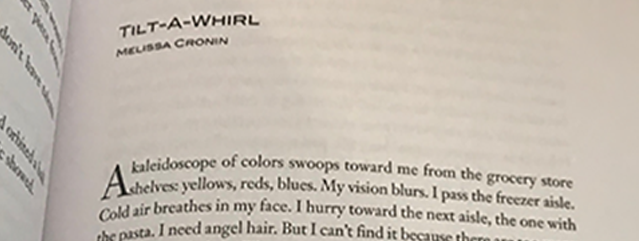
I’m here to share some good news. My story, “Tilt-A-Whirl,” has been published in issue 12 of Tahoma Literary Review. How many of us have been to an amusement park? Do you remember the Tilt-A-Whirl? You know, that ride that whips you around and around, your body being pulled one way, your head, and brain, being pulled the other. For some reason, I used to love that vertigo-like feeling as a kid, but that was long before my brain injury. Now, forget it; I’ll take a ticket for the merry-go-round.

If you haven’t had the woozy, though weirdly fun, experience of riding on a Tilt-A-Whirl, then you’re in for a good time: “Tilt-A-Whirl” it invites you, my dear readers, into the dizzying yet sometimes comical life of a traumatic brain injury survivor (me), providing a zoomed-in snapshot of the inner workings of a brain re-wired by trauma. You get to travel along with me as I navigate my way through an afternoon of shopping. (I bet you can’t wait!) While “Tilt-A-Whirl” highlights my own, brain-drain experience, the story is far reaching. Even if you don’t have a brain injury, you may find that you have similar every-day experiences, though with different perspectives, to share. So, all you have to do is click here, and pay a nominal fee of $10.99 for a hard copy; $2.59 for digital (includes 28 other fantabulous literary perspectives on many of today’s social issues). Then buckle up, and enjoy the ride!

If you feel at all light-headed, no worries, it will pass, I promise.

And, please, feel free to invite a friend, or two or three, to ride/read along with you.

Again, enjoy the ride!


Read More

Traumatic Brain Injuries 101

brain_injuries_101

Traumatic Brain Injuries 101 In the United States, 52,000 deaths occur each year from a traumatic brain injury (TBI), and 5.3 million people live with disabilities due to a TBI. But a TBI does not necessarily result from a major trauma, like skiing into a tree or plummeting off a roof. You can sustain a TBI from bumping your head on a kitchen cabinet door, or when you and your five year old smack foreheads while wrestling. Penetrating injuries – from a bullet, or other objects that enter the skull – can also cause TBI’s. But the most common causes are from auto accidents and falls.

TBIs range from mild to severe. Mild injuries – concussions – are the most common. Symptoms include confusion, irritability, nausea, fatigue, amnesia around the event, and loss of consciousness up to 30 minutes. But it’s possible to suffer a mild TBI and not lose consciousness. Also, being diagnosed with a mild TBI does not mean the consequences are mild, such as decreased concentration and attention, getting lost and confused, headaches, dizziness, depression, mood swings, sleep disturbances, and difficulty with balance. Many people experience these symptoms for years, which is what happened to me. I still suffer from poor concentration, depression, difficulty multi-tasking, planning and even judging distance. When driving, for instance, I have trouble thinking ahead (at least that’s what my husband tells me). But it’s true. My brain can’t process all the stimuli coming at me: other cars, beeping horns, bicycles, and joggers. It doesn’t have enough room to focus on getting in the left lane soon enough so I can take a left turn.

In moderate TBI’s, the individual loses consciousness from 30 minutes to 24 hours, and in severe TBIs, longer than 24 hours. Symptoms are worse for people diagnosed with moderate to severe TBIs. They tend to exhibit obvious behavioral issues like aggression, and suffer greater physical impairments, like decreased ability to smell (anosmia), ringing in the ears (tinnitus), paralysis, and slurred speech.

But the challenge is in diagnosing TBIs, especially mild ones (like I said earlier, mild from a trauma perspective, not from a consequence perspective. I’ll address the nuances of this in a future post). My TBI was diagnosed in 2006, three years after I sustained the injury. During the immediate hours after the accident, the doctors where concerned with my other injuries – stopping the bleeding from my ruptured spleen and stabilizing my fractured pelvis. So I struggled in the workplace for two years, and at home, blaming my symptoms wholly on PTSD.

http://www.northeastern.edu/nutraumaticbraininjury/consequences-of-tbi/

Read More