“Fix Your Gut, Fix Your Brain”

Just when you think you might know all there is to know about how to heal your brain after a traumatic head injury (or how to prevent your brain from a dementia downslide), there’s more. Last week, during Vermont’s 30th Brain Injury Association Conference, I sat in awe of how much I didn’t know when Chiropractor, Wellness Expert, and Clinical Director of  Vizuri Health Center Dr. Bill Schenck  spoke about the relationship between the gut and the brain. In his presentation, “Fix Your Gut, Fix Your Brain,” he could not have underscored more the three fundamental things that can been done to fix your brain. Exercise. Sleep. Healthy foods. While the first two do not directly relate to the gut, they do impact the functioning of the brain.

So, where to start?

Move. Exercise helps the body heal itself. It increases nerve growth in the brain, makes new connections between neurons, and forms new arteries. The more we move, “burn, pant, and sweat,” as Dr. Schenck says, the more human growth hormone we produce, which promotes cell replication stabilizes blood sugar, and maintains testosterone (good for male and females). Moving the spine alone is responsible for 90% of stimulation to the spine, he says. If you’re like me, and are inclined at times to choose the computer over the elliptical, remember, sitting is the new smoking.

Sleep: Damage to neurons do not recover from loss of sleep, meaning less than seven hours a night. Most of us need between 7-9 hours. And the last two hours are the most crucial: that’s when toxins  are cleared from the brain, namely tau proteins, proteins associated with Alzheimer’s. So, as much as you you say you’re all good with five, six, hours of sleep, your brain is not as happy as you might think.

Healthy Foods:

Because there’s no harm in repetition (right?), I’ll start with what Dr. Schneck told us, which we’ve all heard a million times over: Eat a rainbow of veggies and fruits. Everyday. If the name of the fruit ends in berry, it’s good for you (thank you Dr. Schenck for that one!) I know, this makes me sound like an advertisement, but, hey, so what: “Eat More Kale.” And don’t forget avocado. (Is avocado a fruit or a vegetable? I can never remember.)

If possible, eat foods that are fresh, organic, local, and non-GMO. Again, what we’ve heard a million times over: Avoid foods with a high glycemic index (a ranking of carbohydrates in foods and how they affect glucose levels), like all things white (white bread, white rice, white potatoes, white pasta, you get the idea). But certain white foods are okay. Cauliflower, coconut, and one I never would have thought of: Daikon radish – Dr. Schenck says it’s alkalizing, and from what I learned in nursing school light-years ago, our bodies are happiest when in the middle, not too acidic, not too alkaline. An acidic environment is a recipe for illness and chronic disease. If you can’t bear to give up potatoes, the good news is this: sweet potatoes are on the good list, so too are Yukon gold.

Of course, we also need protein. The best source comes from wild caught salmon. Not the farm-raised stuff that’s injected with dye and makes the salmon look like a pink Crayola crayon. East coast salmon is most likely farm-raised, so its’ best to go with Alaskan. It just so happens to be the season for Alaskan salmon, so now’s the time to stock up. Make sure you avoid fish high up on the food chain: the higher up, the more mercury – not at all good for the brain. If you’re an uncompromising carnivore, make sure what you put in your gut is local and grass fed. The same goes for eggs. Grain fed meats, eggs, grain fed anything, cause chronic inflammation in the body.

When Dr. Schenck talked about oils, I sat up a bit straighter in my chair (I thought I was doing such a good job using only good oils.) I’ve been smearing Earth Balance on my toast for years, and when he mentioned safflower and canola oils as being toxic, I thought, yikes, both are among the first ingredients in the  yummy, buttery spread I’ve come to love. Soy, which is 95% GMO, is a no-no too (also in some Earth Balance products). And corn, as in Mazola. These toxic oils, which have too much omega 6, also cause inflammation in the body. Corn alone can lead to “leaky gut.” So what oils are on the yes list?  Fish oil ranks at the top. For a healthy brain, we need DHA, so the more DHA from fish oils the better. The best source comes from squid. (Sorry, fried calamari doesn’t count. All fried food is on the no-no list; yes, even french fries, unless they’re baked, and made from sweet potatoes, or Yukon Gold.) Added sugar too is a no-no, so is alcohol (Though, I’m thinking one glass of red wine in the evening has to be okay. Doesn’t it count as a fruit? It’s made from grapes. Yes, that’s a fruit.)

Probiotics:

Try Kombucha, the fermented drink that’s gluten-free, vegan, helps with digestion, boosts your immune system, and wards off high blood pressure and heart disease.  (Who knows, it might even heal your stubbed toe or mosquito bite or lazy eye – I’m a hard-core Kombucha drinker, and I’ve seen no results for the latter.)

Kimchee (my palate is still struggling with this), sauerkraut, tempeh, too are all good sources of probiotics.

Oh, one more thing on the no-no list I almost forgot to share from Dr. Schenck:  Avoid toxic people.


* Remember: I am not a nutritionist, dietician, medical doctor, exercise physiologist, sleep specialist, or wellness expert. I am a nurse turned writer who is living as whole a life as possible with a brain injury, and is interested in helping others struggling with a TBI.

(For information about how certain vitamins, such as vitamin D and omega 3, help heal a TBI, please see earlier postings on my website.)

Happy Healing!


Read More
Concussions

For some – especially those of us who have sustained a traumatic brain injury (TBI) – football is synonymous with concussion. And since football season is upon us once again, I thought this would be the perfect time to re-visit the topic of concussions. To get more to the point, as the Brain Injury Association of Nova Scotia asks of us – both the brain-injured and non-brain-injured – “Please keep this in mind …”

A concussion is an invisible disability.

Everyone’s brain and brain injury are different. It is a many layered issue. If you’ve had a concussion and recovered, what worked for you may not be best for me.

A concussion is not just a headache. It affects everything I do.

It’s not that I don’t want to do things, it’s that I can’t.

I’m doing my best, but my best may not be your best.

My symptoms may change day-to-day. Because I’m doing better one day, does not mean I’m better overall. If I have a bad day after a good one, I am not making it up.

I am not attention-seeking. My pain is real. I need validation.

Due to my unpredictable symptoms, I have trouble meeting timeline expectations (i.e. in work settings).

If I over-exert myself physically or mentally, I may feel the effects of that for many days.

My emotions may be heightened. I may be more reactive to situations that didn’t bother me before.

I may have stress and anxiety from my injury and the recovery process.

I may have issues with my mental health afterward.

My self-worth may be impacted, especially if is tied to my ability and productivity.

I may need some scheduled down-time and alone time. It doesn’t mean I don’t enjoy your company; I just need to take care of myself first.

The fact that it’s hard for me to articulate my symptoms and feelings is part of the injury.

Thank you, everyone, for reading this!

And thank you, Brain Injury Association of Nova Scotia.


Read More

Traumatic Brain Injuries: Vision Therapy

It’s been nearly fifteen years since I sustained a traumatic brain injury, and though you would think my brain should have fully healed by now, that’s not the case. In reality, the healing process for most brain injuries is ongoing, a lifetime of ongoing. I’ve submitted to all kinds of therapies over the years – cognitive therapy, herbal therapy, meditation, yoga, medications, e-stim, the list goes on. Now, in my efforts toward continued healing, I am a believer in  vision therapy.

Fifteen years ago, even as recent as three years ago, if someone had mentioned vision therapy to me as a possible treatment for my sensitivity to bright lights, as a solution to the dizzying fatigue I experience when in the grocery store, a shopping mall, at a July 4thcelebration with dozens of fireworks lighting the night sky in frenzied colors, I would said, “What? Why vision therapy? And what the heck do you mean by vision therapy anyway?” Though knew of certain kinds of therapies for vision difficulties, like a lazy eye (I had to wear an eye-patch when I was a kid to correct my right eye that wandered like a toddler first learning to walk), I had never heard of vision therapy as a treatment option for TBI-related vision difficulties (FYI: not  only injuries caused by external trauma, but also injuries that are acquired, like a stroke or a tumor, can affect visual processing.)

We typically think of vision as what we see, but, dare I use a cliché, there’s more to vision than meets the eye. Vision also includes how the brain processes what we see. So, though I have 20/20 vision (when wearing my glasses), my brain struggles with interpreting images sent from the retina.

I’ve known for a long time now that something is wrong with my brain’s ability to process visual information, but because I’ve become used to melting into a puddle of confusion every time I walk down the cereal isle, with its endless options of whole-wheat, sugar free, and non-GMO, I’ve forgotten what it’s like to feel balanced and solid on two feet. (Thank God my husband loves to shop, sparing my brain the energy depletion of just walking into a store.)

Sometimes my brain signal’s my eye to read words on the page as a blurred mess, or my mind’s eye misconstrues words. When out for a walk, I sometimes see things coming at me from my right or left, like a flying rock, or a rogue tree branch, or an angry bird, when in fact none of those things are there at all. Not too long ago, my brain interpreted a fire hydrant as a dog. (No, I’m not on drugs, not the kind you might think I’m on anyway.)

Finally, just this past month, I decided it was about time I see an optometrist for a visual processing assessment. Honestly, the hour-and-a-half of testing was more like eye gymnastics. Here’s just a fraction of what that workout involved:

A kinetic field test in which I looked through a viewfinder with one eye closed. With that same eye fixed on a center point, the examiner shifted a pointer with a white tip beyond my visual field. Each time the pointer returned, I let her know that I could see it. I did this several times, each time the tip of the pointer a different color. Then I followed the same process with the opposite eye.

After that, I spent more than an hour with the optometrist. She first asked me to read various lines of letters on an eye chart. Then, as I looked through a viewfinder, she flickered a foggy, whitish light onto a chart that made it appear as if the letter U was floating all over the place, and asked me if I could see double. Yes, I did, but only once. Other than that, my eyes had trouble keeping up with the U. Then she had me close my eyes, and while she jingled a set of keys, I tried to touch them with one finger. I can’t explain exactly what the test reveals, but since the auditory and visual neuro-pathways run close together, if you’re struggling with visual processing it makes sense that you might also have difficulties with auditory stimuli, as in hyper-sensitivity to certain sounds. (The sound of crinkling plastic bags drives me crazy.)

Then, while looking through the viewfinder, the optometrist slipped in and out of the machine various shades of lenses, and asked which ones made my vision blurry, versus ones that made me see with clarity. A strange thing happened at one point. As she slipped in one of the lenses (one with a blue tint), I felt my stomach relax, a letting go of something – anxiety, stress. When I told her what had happened, she nodded, explaining that some people experience a visceral relaxation. I couldn’t believe it. I wanted more blue, more of letting go. That’s when she said I would benefit from therapeutic glasses with blue-tinted lenses. They’re nothing like every-day prescription glasses; they’re designed as a treatment for visual processing issues. At first, you wear them for only a few hours a day, slowly increasing the amount of hours over time. I’m still waiting for my new glasses to arrive in the mail.

Meanwhile, in an effort to recruit new brain/vision-related neuro-pathways, I’m following the optometrist’s instructions and practicing in-home eye-tracking gymnastics five days a week. While the exercises are yet one more thing on my brain-health to-do list, they’re worth it. After all, it would be nice to go for a walk without worrying about getting bit by a firehydrant.


Read More

Brain Injury Awareness Month

brain injury awareness month

It’s March, the time of year when we begin to think about daffodils, Easter bunnies, Passover Seders, and, of course, day light savings time. The month of March reminds us to act on our thoughts, to effect change, to move forward; After all, March was named after Mars, the God of war. This doesn’t mean we should act through violence. Because Mars was also known as the God of agriculture and fertility, March is a time for new growth. How do we grow? Through awareness. So it logically follows that March has been designated as Brain Injury Awareness Month.

Every March, The Brain Injury Association of America leads the nation in observing Brain Injury Awareness Month by holding awareness campaigns. These campaigns aim to educate the public about an often misunderstood and misdiagnosed injury, including the incidences of brain injury, and ways in which we can help the injured and their families. It’s also an opportunity to work with communities on how to empower brain injury survivors without stigmatization.

To help you understand a little about brain injuries, here are some facts from the Brain Injury Association of America to get you started:

More than 2.5 million people in the U.S. sustain a TBI each year.

137 people die each day due to a TBI.

Most TBIs are due to falls.

5.3 million Americans live with disabilities as a result of a TBI.

Acquired brain injury (ABI) is an injury to the brain that is not congenital, hereditary, degenerative, or caused by birth trauma. Examples of causes include: electric shock, infections, near drowning, strokes, and tumors.

A TBI is a subset of ABI and is caused by trauma from an external source such as a bullet wound, falls, or car accidents.

To learn more about brain injuries, including the latest research, legislative briefs, and the social stigmas attached to having a brain injury, I encourage you read more by clicking on the following links:

Brain injury facts

Brain injury legislation

Brain injury awareness month

Differences between boys’ and girls’ brains

Inosine treatment for brain injuries may help motor function recovery

Scientists take big steps toward being able to repair brain injuries

To Share or Not to Share: Life after a Brain Injury

Marginalization of people with brain injuries


Read More

March for Women, Compassion, Unity, Equality

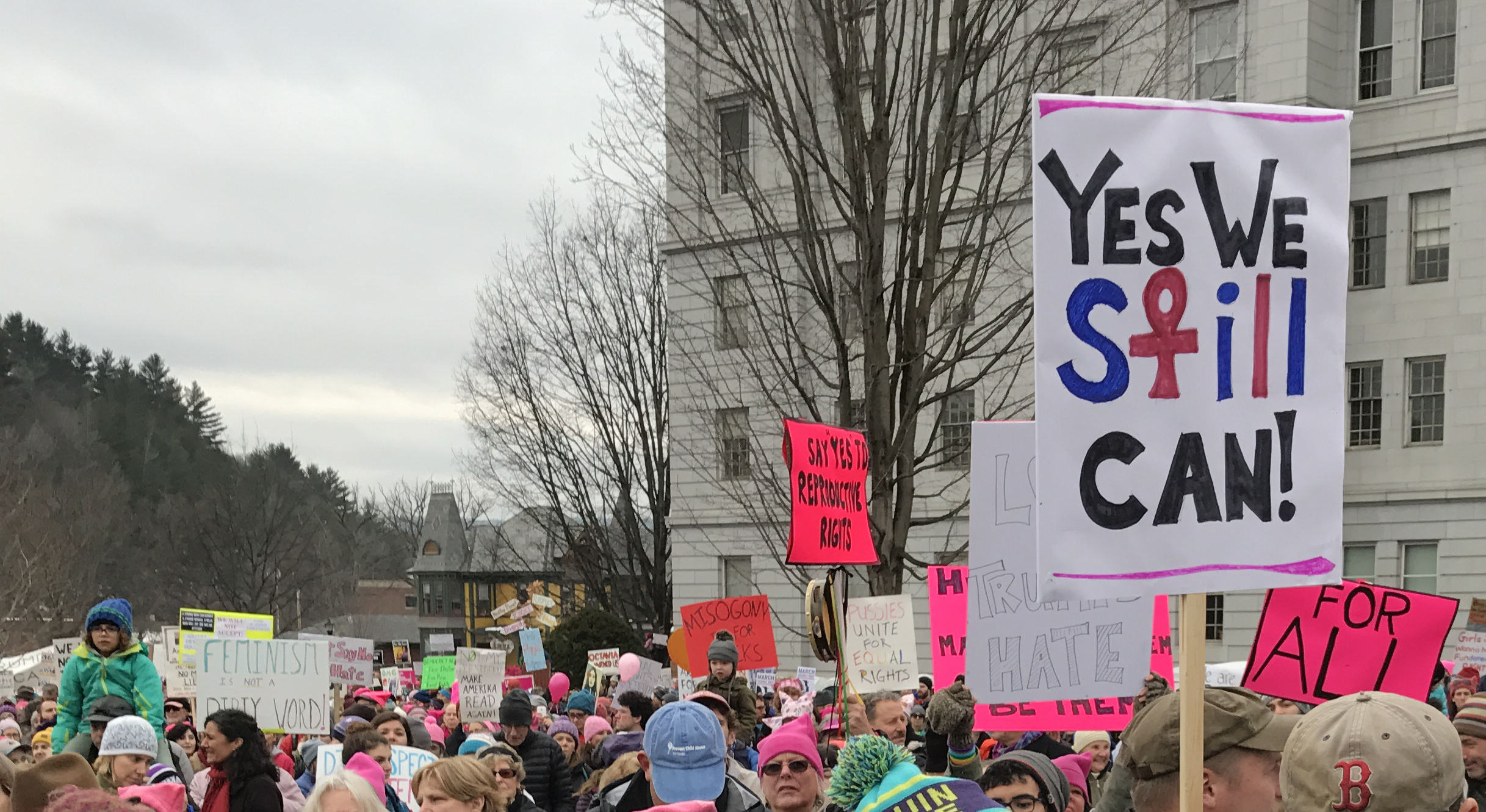
yes_we_canThis past Saturday, at least fifteen thousand people marched through downtown Montpelier, Vermont, in the name of women’s rights, human rights, compassion, unity, and equality. I was among the thousands who sloshed through mud puddles and climbed over snow banks, each one of us determined to stamp out hatred and bigotry.

I’m not one for crowds, especially large crowds; if you have an anxiety disorder, like PTSD, you know what I mean. But I packed my Xanax – just in case – and drove the 40 miles with my step-daughter (thank you Rachel for being there with me) from Burlington to Montpelier, waited in five-miles of backed up traffic on the interstate before making an illegal U-turn (I can’t tell you how good it felt to break the law!) so we could exit onto an alternate route leading into town, then parked a mile from the state house. From there, Rachel and I took our first steps toward the center of inclusivity: the golden-domed state house.

Montpelier may be the smallest capital in the nation, but our voices here in Vermont are far from small. Yesterday, as we marched together, thousands waved signs reading, “Yes we still can … We should all be feminists … We the people … complacency is complicity.” We sang and chanted and shouted against oppression and injustice. We spoke out loud for what is right: helping the homeless and the poor, treating with dignity women, people of color, Hispanics, Jews, Muslims, gays, LGBQTs, the young and the old. And the disabled.

I give the disabled a sentence of its own, not because I believe they’re superior to others; I do so because I know too many disabled people, mostly those who have sustained traumatic brain injuries (TBI) and are now living with chronic side-effects, such as vision difficulties, chronic anxiety, sleep disorders, and rip-roaring headaches. Due to their injuries, some find it difficult to engage in substantial gainful activity, a social security disability insurance (SSDI) term meaning your medical condition prevents you from doing more than “insignificant” work. And if your disability prevents you from working twenty hours or more a week, the typical threshold for receiving employer-based benefits, this likely outcome is this: no health insurance. With the enactment of the Affordable Care Act, though, those with disabilities had options, and they didn’t have to worry about being discriminated against for having a pre-existing condition (a TBI for instance). The ACA offered increased accessibility to community health centers, and enacted a provision that axed annual and life time limits – a godsend for people with disabilities. For those who receive SSDI and Medicare under the program’s guidelines, they are (or should I say “were?”) protected.

But it’s 2017, and winter has arrived. “He who must not be named” plans to eviscerate the ACA, with no alternative other than the ambiguous executive order he signed just hour after he was inaugurated directing federal agencies to relieve individuals, state governments, businesses, and health insurance companies from “burdens” placed on them by the ACA.

Whatever that means? In the meantime, there are nearly 50 million people in the U.S. who have a disability, and about 8.8 million who receive SSDI benefits. Though “he who must not be named” promises Medicare for All, this is sheer talk from a man who, well, likes to talk. And, of course, “he” has to deal with the Republican controlled congress. What do the millions receiving Medicare under SSDI benefits – and those sixty-five and older – have to look forward to?

I wish I had a magic wand to make it all better, but I don’t. Yet, I do have my voice. I share my voice with you, sing and chant and cheer for you, keeping in mind the words that Martin Luther King Jr. spoke in 1965: “Our lives begin to end the day we become silent about the things that matter.”

The more we speak, the louder we speak, “about the things that matter,” the closer we come together, marching forward toward human progress and shaping a world in which every single one of us matters.


Read More