“Surviving and Thriving”

surviving_thriving

A few weeks ago, I stood on a stage in front of hundreds of people, shaking like a mother@#$%!&, and shared my story of “Surviving and Thriving” at the annual brain injury conference held by the Brain Injury of Association of Vermont. I also listened to others, including mental health providers and rehab specialists – share their experiences with TBIs. As the theme of the conference, “Surviving and “Thriving, came up over and over again, I began to think about what that phrase really means for TBI survivors, and others. I wasn’t looking for the “pull-yourself-up-by-your-bootstraps” kind of answer (I’d like to see someone take on that impossible task, literally.) Of course, precisely how each one of us survives and thrives differs, but I came away from the conference realizing that a common denominator does exist: Human emotion. Because we’re human, we’re vulnerable and experience grief, anger, jealousy, anxiety, and so on. That being the case, I’d like to share some takeaways from the conference, tidbits offered by Psychologist Laura Basili, which define, at least for me and hopefully for you too, the nitty-gritty of “Surviving and Thriving”:

 1) A willingness to remain vulnerable. Being vulnerable is part of “Surviving and Thriving,” though we tend to equate vulnerability with weakness, and who wants to be perceived as weak? But, alas, like I said, we’re all vulnerable, like it or not, and it doesn’t mean we’re weak at all. If you don’t believe me, maybe the poet David Whyte will be more convincing: Vulnerability is not a weakness, a passing indisposition, or something we can arrange to do without, vulnerability is not a choice, vulnerability is the underlying, ever present and abiding under-current of our natural state. To run from vulnerability is to run from the essence of our nature, the attempt to be invulnerable is the vain attempt to be something we are not and most especially, to close off our understanding of the grief of others. More seriously, refusing our vulnerability we refuse the help needed at every turn of our existence and immobilize the essential, tidal and conversational foundations of our identity.

The operative phrases, which are worthy of repeating, are in the last two sentences: To be invulnerable is … to close off our understanding of the grief of others. More seriously, refusing our vulnerability we refuse the help needed at every turn of our existence and immobilize the essential, tidal and conversational foundations of our identity.

So why not wrap your arms around vulnerability, walk alongside it, or invite it into your home?

2) We first need to understand grief before we can grieve what we’ve lost – maybe it’s the loss of independence after a brain injury or the death of a loved one from a TBI, or any other kind of loss. But grief doesn’t only come in the form of sadness; it also presents itself as anger, denial, guilt, fatigue, desperation, hyper-vigilance, resentment, and anxiety. So when you’re socked-in by one of those emotions in the aftermath of a loss, know that you’re doing what humans do: grieving. To grieve is to grow, meaning you’re “Surviving and Thriving.” As Laura does with some of her patients, if you’re struggling with grief, you might want to try drawing a picture of suffering, then drawing one that resembles hope. I’d love to see what you come up with.

Oh, I almost forgot one more tidbit, something that brain injury survivor Hannah Wood shared during her keynote address: Do one thing every day that scares you. That doesn’t mean you have to free climb up the face of Half Dome in Yosemite or go skydiving. Maybe it’s applying for that dream job you’ve been telling yourself you’re not qualified for because you’re afraid of being rejected. Maybe it’s making that phone call to a certain individual who has experienced a similar traumatic experience as you, but you’ve held off, afraid she’ll tell you she doesn’t want to talk about it. Whatever the scary thing might be, go for it! After all, as Laura shared with the audience from one of her clients, “The suffering is in the waiting.”


Read More
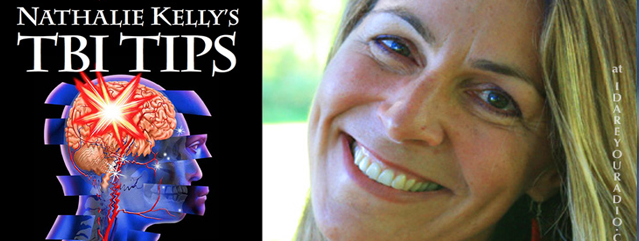
Meet Nathalie Kelly: Daring Dreamers Radio

Nathalie Kelly

What is it like to live with a traumatic brain injury (TBI)? Maybe you feel as if you know longer know who you are. You might say that your identity has been “stripped” away, that your independence has been ripped from you. You feel utterly lost. In an interview with marketing consultant Angela Treat Lyon on Daring Dreamers Radio, this is exactly how Nathalie Kelly, a TBI survivor, describes how she felt in the days, months, and years after her sailboat toppled over during a storm on Lake Champlain in Vermont and smacked her in the head, leaving her bobbing in the cold water for forty minutes, until the coast guard arrived.

A brain injury advocate, writer, inspirational speaker, and board certified hypnotherapist, Nathalie speaks with eloquence and candor about her post-TBI road-blocks, set-backs, growth-spurts, and more. The motto of Daring Dreamers Radio is “to dare you to live free, inspired, and in constant delight.” And that is precisely what Nathalie does in the interview: She has come to understand that living with a TBI means learning to accept that you are “perfectly imperfect,” and, though our culture frowns upon anything less than perfection, she “dares” us to embrace it, to “embrace vulnerability,” to let yourself be the person you are now, to shed all expectations of others. “That’s living an authentic life,” Nathalie says.

To be inspired and awakened and free, I dare you to listen to Nathalie’s interview at Daring Dreamers Radio.


Read More

Compassion Fatigue

You’ve heard of “burnout,” right? Your work environment is making you miserable, so miserable that you feel unfulfilled, depleted of energy, stripped of all motivation to effect change in the workplace. If you’re a healthcare professional, undoubtedly, you know all too well about burnout. But then there’s “compassion fatigue.” While individuals working in any kind of job setting can experience burnout, compassion fatigue is unique to those exposed to trauma while working in a helping profession: nurses, firefighters, police. Because you’re in the helping profession, you feel the onus is on you to save peoples’ lives, to make them better, to alleviate their pain, so you sign up for extra shifts, and, if you’re a nurse, offer to take care of the sickest patients. But what happens when your patients have little, or no family support, or are constantly ringing the call bell, making demands (get me water, I need more pain meds, I need something to help me sleep)? You feel like Sisyphus – no matter how many times you push the boulder up the hill, it keeps rolling back down into your weakened arms. You’re worn down, irritable, angry. That’s compassion fatigue, when you can no longer muster the sympathy to care for your patients because you’ve been exposed to the same kinds of patients again and again, and have answered an uncountable number of call-bell dings, but the bells keep dinging, and you want to keep helping, but, at the same time, you want to run.

It’s worth noting, however, that compassion fatigue doesn’t necessarily mean individuals experiencing it lack compassion, not at all. They still care about their patients. Instead, as a nursing professor at the College of Nursing at University of Arizona says, compassion fatigue is more like feeling too “full,” and even suggests a different name for it: “emotional saturation.”

Not only are healthcare professionals at risk for compassion fatigue, though, family members caring for loved ones with, say, a traumatic brain injury or dementia, are at risk too. Even those who hear about another’s traumatic experience over and over again are affected. I bring these scenarios into the mix because, sadly enough, I suffered from compassion fatigue when I worked tirelessly to navigate my father’s emotional swings, and, as he slipped into Alzheimer’s, made sure he was safe at home because he had insisted he never be put in a nursing home. And I’m witnessing compassion fatigue again, as my husband and his siblings stumble then pick themselves each day, determined to keep their aging mother safe from the ravages of dementia.

But it is possible to care too much, so much that it hurts. When I say hurt, I mean really hurt, as in traumatized hurt. Being pre-occupied with others’ suffering can cause “secondary traumatic stress” for the helping individual. It’s not unusual to experiences symptoms of post-traumatic stress disorder: anxiety, hyper-vigilance, irritability, impatience, withdrawal, poor concentration, sleep disturbance, nightmares, the list goes on.

What’s the cure for compassion fatigue? Boundaries and self-care. In other words, set limits, say no even when you want to say yes, remind yourself to take time out, meditate, go for a walk, keep a journal, draw, listen to your favorite music, dance, do yoga, take a bath, read a novel, watch a funny movie. Watch the sun set. Watch the sun rise.

For more resources on how to evaluate whether or not you have compassion fatigue and how to prevent/treat it, go to compassion fatigue and healthy caregiving.


Read More

What Not to Say to Someone with a Brain Injury

what_not _to_ask_ someone_with_a_tbi

At the Vermont Brain Injury Conference last fall, a TBI survivor, who sustained his injury years ago, spoke to an audience of nearly four hundred people. He didn’t have any visible scars, difficulty with speech, or an obvious limp to his gait. He spoke clearly and eloquently, and, in fact, was back in school pursuing a college degree. Because he appears healthy and strong, he explained how those without a TBI often don’t know what to say to him when they learn that he sustained a TBI. I recall him saying to the audience something like, “I’m me.” In other words, he was affirming his TBI, not from the perspective of a victim, but from the perspective of an individual who has accepted his disability, who has learned to cope with the challenges he faces each day, and who wants others to know that, though he looks “normal,” he cannot do everything others can do.

He left me thinking, thinking a lot, about how confusing a TBI is for those who do not have one, especially if they cannot see or hear it – the scars, the limp, the slowed speech. We all mean well (or I like to think so), and when we meet someone with a TBI, or any kind of disability, it’s natural to want to offer an opinion or suggestion, even if it’s unsolicited. I’ve done it myself, and I have a TBI. A few months ago, when walking on the treadmill in the gym where I live, a middle-aged woman with a cane shuffled in, one foot dragging along the carpet. The arm on the same side of the dragging foot hung limp. Her speech was slurred when she said hello. I assumed she had had a stroke. I smiled at her and introduced myself. I watched her struggle to lift herself up onto the seat of the stationary bike, and suggested that she might want to try the recumbent bike. She responded with a soft voice, saying that she had trouble adjusting the seat of the recumbent bike. I offered to help her, but she said she could manage herself. “Are you sure?” I asked. “Yeah, I’ll figure it out.” She did. Though I was being helpful, I wasn’t. She needed to figure out, on her own, how to adjust the seat. If she needed my help, she would have asked me.

While we may mean well when interacting with someone who has an invisible TBI, or any invisible disability, there are an untold number of statements we may find ourselves saying (some of them people have said to me), that are not helpful, but hurtful. It can be said that such statements are not only meant as an attempt to be helpful, but also as a diversion from facing our own morbidity, and mortality. For instance, it’s easier to say to someone with a TBI, “But you look great,” than to say nothing at all, which would leave too much space in your mind for thoughts of your own vulnerability.

To learn what not to say to people with a TBI, go to Brainline. This same site offers other communication strategies when interacting with TBI survivors, including those with post-traumatic stress disorder. But please know that by sharing this list, my intention is not to be prescriptive or didactic. Dare I say it … it’s my way of making a suggestion. (Maybe I’m not being very helpful, but I can only hope so.)

Thanks for considering these tips!


Read More

Visual Art and the Brain

Do you enjoy drawing, coloring, painting? So what if you are not a Picasso or a Van Gogh.  What I’m about to share with you just might inspire you to head out to your local art shop for colored pencils and a drawing pad. Research suggests that creating visual art enhances memory, and improves interactions between certain parts of the brain. Based on feedback from a small group of retirees, improvement in brain functioning may also strengthen one’s psychological state of mind.  This seems logical. After all, as researchers say, “The creation of visual art is a personal integrative experience—an experience of ‘flow,’ in which the participant is fully emerged in the creative activity.” With that integration, brain connections are strengthened, which, in turn, boosts self-confidence.

For individuals with a TBI, art is a form of therapy. It restores connections in the brain damaged by trauma. This restoration process is called neuroplasticity: the changes in nerve pathways of the brain that affect behavior. Yes, we can actually re-wire our brains by intentionally changing the way we think and do things. Since 2010, therapists at the National Intrepid Center of Excellence (NICoE), at Fort Belvoir, Virginia have been using art as a tool in treating war veterans who have sustained TBIs.

Art therapy does more than help to heal an injured brain. Jackie Briggs, a therapist at NICoE says, “For service members who might already have trouble expressing themselves … art therapy gives them a chance to use free expression, allowing whatever needs to bubble up from below the surface to be seen and evaluated.” When thoughts “bubble” up, service members gain a better understanding of their symptoms such as irritability, anxiety, and depression. With that deeper understanding, their relationships benefit, because they are able to effectively unearth their buried feelings and thoughts.

At NICoE, service members decorate blank papier-mâché masks. The reasoning behind using this form of art therapy is based on how trauma works; it blocks the part of the brain responsible for speech and language. The image of the mask itself is tangible, a concrete method of showing how service members are feeling. As one of the therapists at NICoE says, “the masks have given service members a visual voice.” The added benefit is that they know they are not being judged, or critiqued. Making the masks affords them the opportunity to explore, engage in the process of creating something that encourages free expression.

The formof art doesn’t matter. Art is art. Juliet Madsen, a veteran of two wars who sustained a TBI when a roadside bomb hit her convoy, likes to doodle. In an email exchange with her this past fall this is what she had to say about doodling:

Doodling stimulates your creative side, allows your body to calm down, takes the active stresses and puts them on the back burner, can sometimes give you an artistic answer to your problems if you open to it, and gives you a time out… I am a big fan. Once you are an accomplished Doodle Artist take a set of colored pencils to your work or thin point sharpies, then you are really working it.

Juliet inspired me. I bought myself a sketchpad and sharpie and started doodling. I’m now a big fan too!

Are you a doodler, a painter, a sketcher, a creator of masks? If not, why not join in. Grab a sharpie, a pen or pencil, a paintbrush. As Juliet said, “Stimulate your creative side.”

Cheers to free expression, to an integrative experience – and to a healthy brain!

If you want to learn more about the masks service members have created, read the “The Invisible War on the Brain,” published in February 2015 by National Geographic.

http://ngm.nationalgeographic.com/2015/02/table-of-contents

Read More