“Surviving and Thriving”

surviving_thriving

A few weeks ago, I stood on a stage in front of hundreds of people, shaking like a mother@#$%!&, and shared my story of “Surviving and Thriving” at the annual brain injury conference held by the Brain Injury of Association of Vermont. I also listened to others, including mental health providers and rehab specialists – share their experiences with TBIs. As the theme of the conference, “Surviving and “Thriving, came up over and over again, I began to think about what that phrase really means for TBI survivors, and others. I wasn’t looking for the “pull-yourself-up-by-your-bootstraps” kind of answer (I’d like to see someone take on that impossible task, literally.) Of course, precisely how each one of us survives and thrives differs, but I came away from the conference realizing that a common denominator does exist: Human emotion. Because we’re human, we’re vulnerable and experience grief, anger, jealousy, anxiety, and so on. That being the case, I’d like to share some takeaways from the conference, tidbits offered by Psychologist Laura Basili, which define, at least for me and hopefully for you too, the nitty-gritty of “Surviving and Thriving”:

 1) A willingness to remain vulnerable. Being vulnerable is part of “Surviving and Thriving,” though we tend to equate vulnerability with weakness, and who wants to be perceived as weak? But, alas, like I said, we’re all vulnerable, like it or not, and it doesn’t mean we’re weak at all. If you don’t believe me, maybe the poet David Whyte will be more convincing: Vulnerability is not a weakness, a passing indisposition, or something we can arrange to do without, vulnerability is not a choice, vulnerability is the underlying, ever present and abiding under-current of our natural state. To run from vulnerability is to run from the essence of our nature, the attempt to be invulnerable is the vain attempt to be something we are not and most especially, to close off our understanding of the grief of others. More seriously, refusing our vulnerability we refuse the help needed at every turn of our existence and immobilize the essential, tidal and conversational foundations of our identity.

The operative phrases, which are worthy of repeating, are in the last two sentences: To be invulnerable is … to close off our understanding of the grief of others. More seriously, refusing our vulnerability we refuse the help needed at every turn of our existence and immobilize the essential, tidal and conversational foundations of our identity.

So why not wrap your arms around vulnerability, walk alongside it, or invite it into your home?

2) We first need to understand grief before we can grieve what we’ve lost – maybe it’s the loss of independence after a brain injury or the death of a loved one from a TBI, or any other kind of loss. But grief doesn’t only come in the form of sadness; it also presents itself as anger, denial, guilt, fatigue, desperation, hyper-vigilance, resentment, and anxiety. So when you’re socked-in by one of those emotions in the aftermath of a loss, know that you’re doing what humans do: grieving. To grieve is to grow, meaning you’re “Surviving and Thriving.” As Laura does with some of her patients, if you’re struggling with grief, you might want to try drawing a picture of suffering, then drawing one that resembles hope. I’d love to see what you come up with.

Oh, I almost forgot one more tidbit, something that brain injury survivor Hannah Wood shared during her keynote address: Do one thing every day that scares you. That doesn’t mean you have to free climb up the face of Half Dome in Yosemite or go skydiving. Maybe it’s applying for that dream job you’ve been telling yourself you’re not qualified for because you’re afraid of being rejected. Maybe it’s making that phone call to a certain individual who has experienced a similar traumatic experience as you, but you’ve held off, afraid she’ll tell you she doesn’t want to talk about it. Whatever the scary thing might be, go for it! After all, as Laura shared with the audience from one of her clients, “The suffering is in the waiting.”


Read More
Meet Nathalie Kelly: Daring Dreamers Radio

Nathalie Kelly

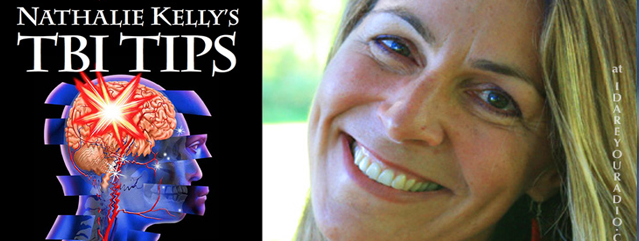
What is it like to live with a traumatic brain injury (TBI)? Maybe you feel as if you know longer know who you are. You might say that your identity has been “stripped” away, that your independence has been ripped from you. You feel utterly lost. In an interview with marketing consultant Angela Treat Lyon on Daring Dreamers Radio, this is exactly how Nathalie Kelly, a TBI survivor, describes how she felt in the days, months, and years after her sailboat toppled over during a storm on Lake Champlain in Vermont and smacked her in the head, leaving her bobbing in the cold water for forty minutes, until the coast guard arrived.

A brain injury advocate, writer, inspirational speaker, and board certified hypnotherapist, Nathalie speaks with eloquence and candor about her post-TBI road-blocks, set-backs, growth-spurts, and more. The motto of Daring Dreamers Radio is “to dare you to live free, inspired, and in constant delight.” And that is precisely what Nathalie does in the interview: She has come to understand that living with a TBI means learning to accept that you are “perfectly imperfect,” and, though our culture frowns upon anything less than perfection, she “dares” us to embrace it, to “embrace vulnerability,” to let yourself be the person you are now, to shed all expectations of others. “That’s living an authentic life,” Nathalie says.

To be inspired and awakened and free, I dare you to listen to Nathalie’s interview at Daring Dreamers Radio.


Read More

Driving after a Traumatic Brain Injury

For most of us, driving equates with independence and freedom. So when you are diagnosed with a traumatic brain injury and learn that you cannot drive at all, or need to limit your driving to daylight hours, you may feel the loss of independence you once enjoyed.

Even with a mild traumatic brain injury, changes in thinking, perception, vision, and motor skills can affect driving: the ability to stay in the correct lane, react quickly when another driver cuts in front of you, and seeing a green light change to red. With a TBI, individuals become easily fatigued and may have difficulty concentrating for long periods of time. They often have difficulty processing rapidly moving stimuli, such as passing cars and bicycles. http://www.biausa.org/brain-injury-community.htm

But the good news is that between thirty and sixty percent of individuals with a moderate to severe traumatic brain injury eventually return to driving. They do so with the help of driving rehabilitation professionals, who first evaluate cognitive functioning, judgment, and reasoning skills. They then conduct a road evaluation. Still, most TBI survivors are not adequately evaluated before getting behind the wheel again. http://www.biausa.org/brain-injury-community.htm

Family members can help too. If it’s your spouse, though, and you prefer to save your marriage, you may want to be evaluated by an objective party like a rehab professional. For me, though, my husband has been helpful (okay, so we’ve had a few spats). Since my TBI has presented with difficulty processing multiple stimuli and anticipating changes down the road, he has spent time with me driving – me behind the wheel and he the passenger – cueing me when to change lanes or to turn. He has also encouraged me not to engage in too much conversation while driving. Because I fatigue easily, I no longer drive long distances – either my husband drives or I take the bus. And he’s aware of what I call my “bad brain” days and initiates driving. More importantly, I’m aware of my “bad brain” days and either limit my driving, or do not drive at all.

Of course, making the change from limitless driving to limited driving has not been easy. I don’t see friends as much as I used to, and I spend more time indoors, especially during the winter. Thank goodness for social media!

How has your TBI limited your ability to drive? How have you learned to cope with the changes?


Read More

How Blueberries Heal a Traumatic Brain Injury

blueberries

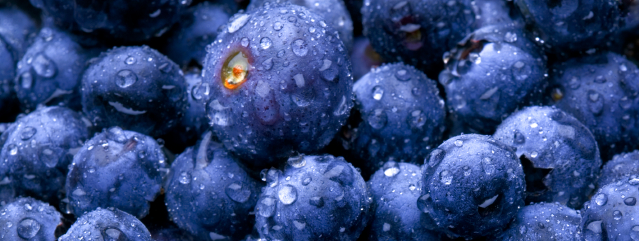
You reach for the bush, grab a cluster of summertime, then pop the handful of nature’s sugar into your mouth. A burst of warmth coats your tongue, meanders down your throat, and you think of homemade jam. You grab another cluster, then another, and eat them all, guilt-free, because you know they are good for you – blueberries.

They may be small, but wrapped inside the sheen of a blueberry skin lies a treasure of health benefits: vitamin C for immunity, manganese for strong bones and for converting fats, proteins and carbohydrates into energy. Blueberries are packed with fiber, which helps reduce cholesterol. Research shows that they even reduce the risk of obesity. Polyphenols – substances that give blueberries their blue-purple color – fight off unstable molecules that put us at risk for heart disease, cancer, and Alzheimer’s disease. Health magazines, Dr. Oz, and likely your own mother, have touted the benefits of eating blueberries. But did you know that these blue jewels, which have been around for more than 13,000 years, might help survivors of traumatic brain injuries recover?

The brain functions normally in the presence of glutamate – a neurotransmitter, or chemical that mediates excitatory signals through the nervous system. But, after a brain injury, glutamate rapidly increases, destroying cells. However, in animal studies, researchers have noted that when extracts from blueberries are added to the cells with glutamate they are actually protected. Though it is not necessarily a good idea to always heed “the more the better,” but “the more berries you eat, the better your brain will be protected if a stroke or traumatic brain injury occurs,” says Dr. John Weber, a researcher at Memorial University’s school of pharmacy. Dr. Weber, and others, is still trying to determine exactly how many blueberries are needed for a specific amount of antioxidants – molecules that combat free radicals, or unstable molecules – to reach the brain, and how long they will remain there.

But Dr. Weber is clear about one thing: those who have suffered a moderate to severe injury might not benefit from eating blueberries. Yet, the extracts in berries might be helpful in the later stages of healing.

Blueberries store well in the freezer –they don’t suffer damage to their fragile polyphenol skins. So, at only 80 calories per cup, stock up, and eat up!

http://www.naturalnews.com/032219_polyphenols_blueberries.html

http://www.blueberrycouncil.org

http://www.whfoods.com/genpage.php?tname=foodspice&dbid=8

http://www.thetelegram.com/News/Local/2014-08-05/article-3823293/Blueberries-could-help-heal-brain-injuries/1

Read More

Fiddling My Way to a Stronger Vocabulary

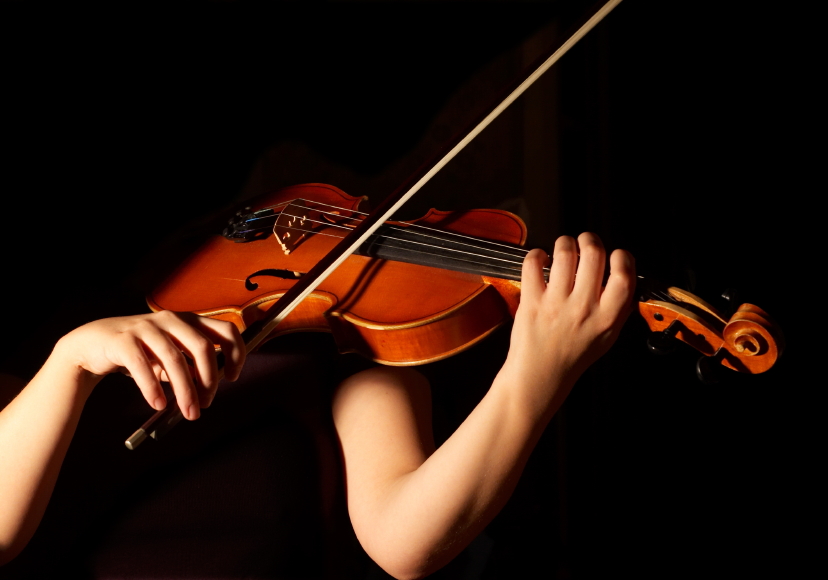
Fiddling my way to a stronger vocabulary 000005217038SmallTen months before I sustained a traumatic brain injury, I started learning how to play the fiddle. Distracted by pain, fatigue and medical appointments during the first months of my recovery I thought I’d never play again. And the few times I tried, the notes sounded either too flat or too sharp. I’d put it back in it’s case, then set it in the corner of the living room, somber and angry at the same time.

Through the persistent support of friends, I eventually practiced again, every day. I started practicing for ten minutes at a time, but quickly increased my sessions to twenty minutes, a half hour, then an hour. I needed the music – immersing myself in the sounds of each note and the melodic phrases of Irish jigs and reels helped me to focus. But I did not know what effect playing the fiddle, or learning any instrument, had on the brains of TBI survivors.

Scientists used to believe that changes in the brain could occur up until only childhood. But modern research has shown that the brain can create new pathways and alter existing damaged ones to form new memories and learn new information. The process, called neuroplasticity (brain remapping) can take months, or even years.

But neuroplasticity can also occur through active learning, called structural plasticity. The brain cannot process all sensory input at once; it selects what it needs from moment to moment. Researchers have found, through music training, areas of the brain involved in cognition such as memory, speech, attention, and language are strengthened. For instance, children who are musically trained have stronger vocabularies and reading skills than those who are not musically trained. Researchers have observed similar patterns in adults.

And so I continue to push the bow across the fiddle’s strings. I call these sessions my brain workout.

http://neurosciencenews.com/neuroscience-music-enchances-learning-neuroplasticity/


Read More