“Tilt-A-Whirl”

I’m here to share some good news. My story, “Tilt-A-Whirl,” has been published in issue 12 of Tahoma Literary Review. How many of us have been to an amusement park? Do you remember the Tilt-A-Whirl? You know, that ride that whips you around and around, your body being pulled one way, your head, and brain, being pulled the other. For some reason, I used to love that vertigo-like feeling as a kid, but that was long before my brain injury. Now, forget it; I’ll take a ticket for the merry-go-round.

If you haven’t had the woozy, though weirdly fun, experience of riding on a Tilt-A-Whirl, then you’re in for a good time: “Tilt-A-Whirl” it invites you, my dear readers, into the dizzying yet sometimes comical life of a traumatic brain injury survivor (me), providing a zoomed-in snapshot of the inner workings of a brain re-wired by trauma. You get to travel along with me as I navigate my way through an afternoon of shopping. (I bet you can’t wait!) While “Tilt-A-Whirl” highlights my own, brain-drain experience, the story is far reaching. Even if you don’t have a brain injury, you may find that you have similar every-day experiences, though with different perspectives, to share. So, all you have to do is click here, and pay a nominal fee of $10.99 for a hard copy; $2.59 for digital (includes 28 other fantabulous literary perspectives on many of today’s social issues). Then buckle up, and enjoy the ride!

If you feel at all light-headed, no worries, it will pass, I promise.

And, please, feel free to invite a friend, or two or three, to ride/read along with you.

Again, enjoy the ride!


Read More

Traumatic Brain Injuries: Vision Therapy

It’s been nearly fifteen years since I sustained a traumatic brain injury, and though you would think my brain should have fully healed by now, that’s not the case. In reality, the healing process for most brain injuries is ongoing, a lifetime of ongoing. I’ve submitted to all kinds of therapies over the years – cognitive therapy, herbal therapy, meditation, yoga, medications, e-stim, the list goes on. Now, in my efforts toward continued healing, I am a believer in  vision therapy.

Fifteen years ago, even as recent as three years ago, if someone had mentioned vision therapy to me as a possible treatment for my sensitivity to bright lights, as a solution to the dizzying fatigue I experience when in the grocery store, a shopping mall, at a July 4thcelebration with dozens of fireworks lighting the night sky in frenzied colors, I would said, “What? Why vision therapy? And what the heck do you mean by vision therapy anyway?” Though knew of certain kinds of therapies for vision difficulties, like a lazy eye (I had to wear an eye-patch when I was a kid to correct my right eye that wandered like a toddler first learning to walk), I had never heard of vision therapy as a treatment option for TBI-related vision difficulties (FYI: not  only injuries caused by external trauma, but also injuries that are acquired, like a stroke or a tumor, can affect visual processing.)

We typically think of vision as what we see, but, dare I use a cliché, there’s more to vision than meets the eye. Vision also includes how the brain processes what we see. So, though I have 20/20 vision (when wearing my glasses), my brain struggles with interpreting images sent from the retina.

I’ve known for a long time now that something is wrong with my brain’s ability to process visual information, but because I’ve become used to melting into a puddle of confusion every time I walk down the cereal isle, with its endless options of whole-wheat, sugar free, and non-GMO, I’ve forgotten what it’s like to feel balanced and solid on two feet. (Thank God my husband loves to shop, sparing my brain the energy depletion of just walking into a store.)

Sometimes my brain signal’s my eye to read words on the page as a blurred mess, or my mind’s eye misconstrues words. When out for a walk, I sometimes see things coming at me from my right or left, like a flying rock, or a rogue tree branch, or an angry bird, when in fact none of those things are there at all. Not too long ago, my brain interpreted a fire hydrant as a dog. (No, I’m not on drugs, not the kind you might think I’m on anyway.)

Finally, just this past month, I decided it was about time I see an optometrist for a visual processing assessment. Honestly, the hour-and-a-half of testing was more like eye gymnastics. Here’s just a fraction of what that workout involved:

A kinetic field test in which I looked through a viewfinder with one eye closed. With that same eye fixed on a center point, the examiner shifted a pointer with a white tip beyond my visual field. Each time the pointer returned, I let her know that I could see it. I did this several times, each time the tip of the pointer a different color. Then I followed the same process with the opposite eye.

After that, I spent more than an hour with the optometrist. She first asked me to read various lines of letters on an eye chart. Then, as I looked through a viewfinder, she flickered a foggy, whitish light onto a chart that made it appear as if the letter U was floating all over the place, and asked me if I could see double. Yes, I did, but only once. Other than that, my eyes had trouble keeping up with the U. Then she had me close my eyes, and while she jingled a set of keys, I tried to touch them with one finger. I can’t explain exactly what the test reveals, but since the auditory and visual neuro-pathways run close together, if you’re struggling with visual processing it makes sense that you might also have difficulties with auditory stimuli, as in hyper-sensitivity to certain sounds. (The sound of crinkling plastic bags drives me crazy.)

Then, while looking through the viewfinder, the optometrist slipped in and out of the machine various shades of lenses, and asked which ones made my vision blurry, versus ones that made me see with clarity. A strange thing happened at one point. As she slipped in one of the lenses (one with a blue tint), I felt my stomach relax, a letting go of something – anxiety, stress. When I told her what had happened, she nodded, explaining that some people experience a visceral relaxation. I couldn’t believe it. I wanted more blue, more of letting go. That’s when she said I would benefit from therapeutic glasses with blue-tinted lenses. They’re nothing like every-day prescription glasses; they’re designed as a treatment for visual processing issues. At first, you wear them for only a few hours a day, slowly increasing the amount of hours over time. I’m still waiting for my new glasses to arrive in the mail.

Meanwhile, in an effort to recruit new brain/vision-related neuro-pathways, I’m following the optometrist’s instructions and practicing in-home eye-tracking gymnastics five days a week. While the exercises are yet one more thing on my brain-health to-do list, they’re worth it. After all, it would be nice to go for a walk without worrying about getting bit by a firehydrant.


Read More
Past Ten

Below is a piece I wrote at the urging of author, editor, and teacher Donald Quist. He asked me to contribute my reflections about how I’ve changed over the previous ten years to his project Past Ten in which various writers share similar recollections. As Donald says, the personal stories in Past Ten are a “testament to the transformative power of time and the human capacity to turn the unpredictable into art.”
Enjoy!


June 21, 2007

It’s 2:06 p.m. The summer solstice. I’m sitting at my desk at the Vermont Lung Association, where I work as an administrative assistant. I’m tapping at the computer keys, logging contributions from donors into an Excel spreadsheet longer than this day. My fingertips turn numb with boredom. My vision blurs from all the lines and rectangles and numbers. Bringg, bringg, bringg. My head thumps with each shrill ring of the telephone. I answer the call from a board member, and pencil his message on a sticky note to be passed on to the CEO. But when I hang up I’ve forgotten his name. Bob? Jim? Ted? My brain’s gas tank is near empty, and I want to lay my head on my desk, nap away this day. I want to sleep off my traumatic brain injury, close my eyes against a diagnosis that still paper cuts my tongue each time I speak it.

It’s been three years since my head smacked against the pavement when a car mowed me down, and no amount of sleep, or even the continuous sunlight on this day can burn off the smog obscuring my mind’s eye from seeing with any kind of mental clarity. I want this day to end. But I must keep tapping, plugging in numbers and names and dates. Filling up the rectangles of a spreadsheet is like filling in the white spaces of my unsure-where-I’m-going-life. How long I’ll pretend I’m happy working here in an office that smells like a basement, with plastic window blinds that clack each time artificial air from the vent gusts its cold breath into the room, I don’t know.

Of course, I’d rather be standing by a newborn’s crib side, where I stood as a nurse for fifteen years. Where I changed diapers, bottle-fed infants their mamas breast milk, cuddled preemies in cotton receiving blankets. But that was before the crash. Now my broken brain couldn’t bear the constant noise of a neonatal intensive care unit: wailing newborns, alarming monitors, dinging IV pumps. That’s why I am here, at this desk, where it’s mostly quiet and I’m asked only to accomplish one job at a time, like filling in rectangle after rectangle. Because it takes all of me to get through this day, I don’t have the mental energy to imagine the formula or function of my future. So I keep tapping.

The planet has raced around the sun ten times since that day. A decade. Another summer solstice has arrived, and I’m still tapping at the computer keys. I’ve figured out my life’s formula, or at least I think I have. With each keystroke, I fill up my own spreadsheet, one I created in 2010, when I enrolled in graduate school for an MFA in writing. That spreadsheet I have replaced with draft after draft of my memoir, with my favorite quotes from authors, blog posts to write, books to read, more books to write.

My brain still must work hard to hold onto names, though, and it still gets low gas mileage. Words and phrases skid away from me, emerge in anagrams, end in ellipses or in incomplete sentences. But I now look forward to the longest day of the year. The sun equals hope; as the days expand, it’s hope that keeps me from tearing up my draft and throwing it in the trash. Hope is the formula and function that carries me through the winter solstice, into the next decade.

Please visit Past Ten to read more inspiring stories.


Read More

Brain Injury Awareness Month

brain injury awareness month

It’s March, the time of year when we begin to think about daffodils, Easter bunnies, Passover Seders, and, of course, day light savings time. The month of March reminds us to act on our thoughts, to effect change, to move forward; After all, March was named after Mars, the God of war. This doesn’t mean we should act through violence. Because Mars was also known as the God of agriculture and fertility, March is a time for new growth. How do we grow? Through awareness. So it logically follows that March has been designated as Brain Injury Awareness Month.

Every March, The Brain Injury Association of America leads the nation in observing Brain Injury Awareness Month by holding awareness campaigns. These campaigns aim to educate the public about an often misunderstood and misdiagnosed injury, including the incidences of brain injury, and ways in which we can help the injured and their families. It’s also an opportunity to work with communities on how to empower brain injury survivors without stigmatization.

To help you understand a little about brain injuries, here are some facts from the Brain Injury Association of America to get you started:

More than 2.5 million people in the U.S. sustain a TBI each year.

137 people die each day due to a TBI.

Most TBIs are due to falls.

5.3 million Americans live with disabilities as a result of a TBI.

Acquired brain injury (ABI) is an injury to the brain that is not congenital, hereditary, degenerative, or caused by birth trauma. Examples of causes include: electric shock, infections, near drowning, strokes, and tumors.

A TBI is a subset of ABI and is caused by trauma from an external source such as a bullet wound, falls, or car accidents.

To learn more about brain injuries, including the latest research, legislative briefs, and the social stigmas attached to having a brain injury, I encourage you read more by clicking on the following links:

Brain injury facts

Brain injury legislation

Brain injury awareness month

Differences between boys’ and girls’ brains

Inosine treatment for brain injuries may help motor function recovery

Scientists take big steps toward being able to repair brain injuries

To Share or Not to Share: Life after a Brain Injury

Marginalization of people with brain injuries


Read More

March for Women, Compassion, Unity, Equality

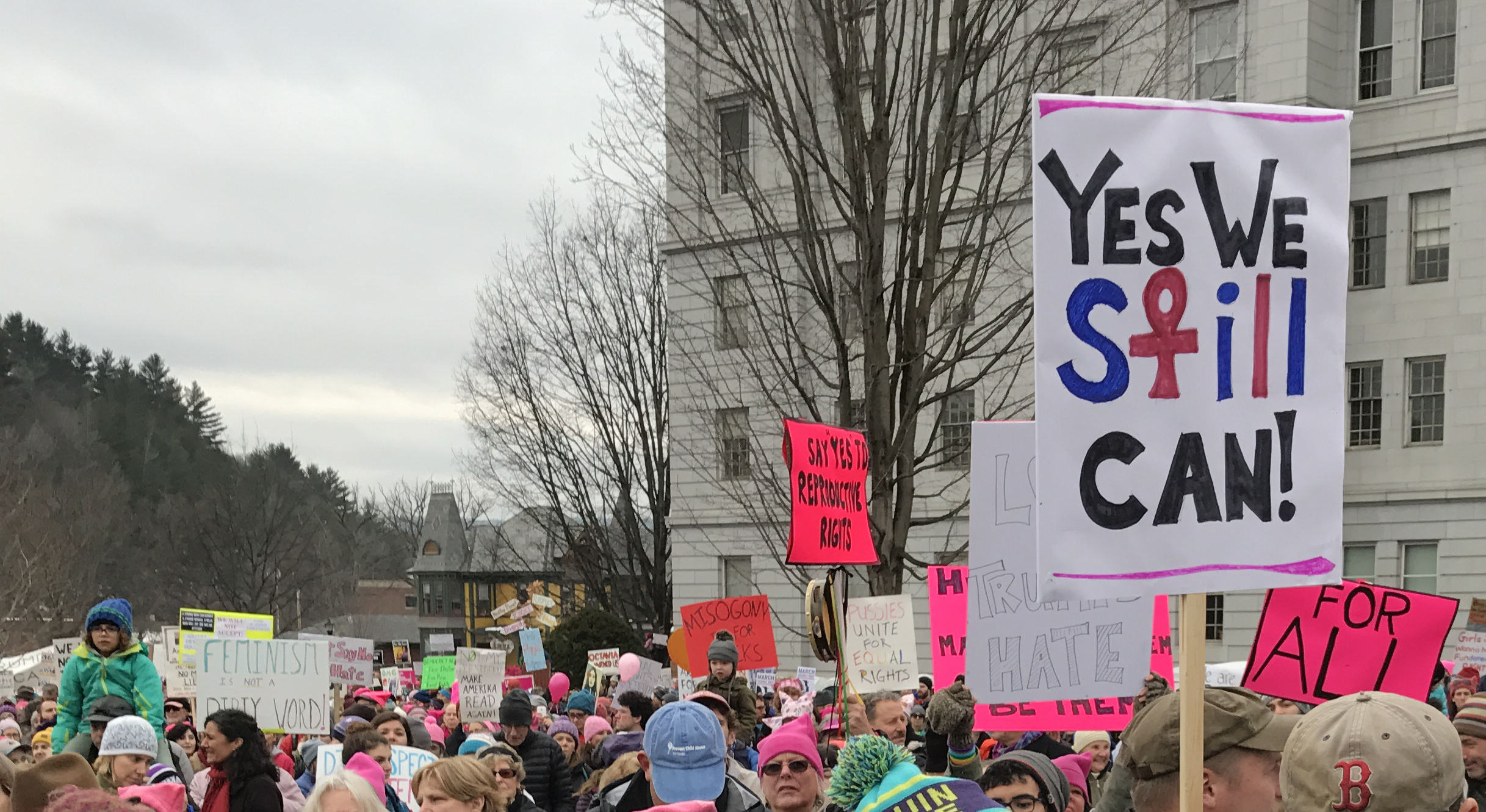
yes_we_canThis past Saturday, at least fifteen thousand people marched through downtown Montpelier, Vermont, in the name of women’s rights, human rights, compassion, unity, and equality. I was among the thousands who sloshed through mud puddles and climbed over snow banks, each one of us determined to stamp out hatred and bigotry.

I’m not one for crowds, especially large crowds; if you have an anxiety disorder, like PTSD, you know what I mean. But I packed my Xanax – just in case – and drove the 40 miles with my step-daughter (thank you Rachel for being there with me) from Burlington to Montpelier, waited in five-miles of backed up traffic on the interstate before making an illegal U-turn (I can’t tell you how good it felt to break the law!) so we could exit onto an alternate route leading into town, then parked a mile from the state house. From there, Rachel and I took our first steps toward the center of inclusivity: the golden-domed state house.

Montpelier may be the smallest capital in the nation, but our voices here in Vermont are far from small. Yesterday, as we marched together, thousands waved signs reading, “Yes we still can … We should all be feminists … We the people … complacency is complicity.” We sang and chanted and shouted against oppression and injustice. We spoke out loud for what is right: helping the homeless and the poor, treating with dignity women, people of color, Hispanics, Jews, Muslims, gays, LGBQTs, the young and the old. And the disabled.

I give the disabled a sentence of its own, not because I believe they’re superior to others; I do so because I know too many disabled people, mostly those who have sustained traumatic brain injuries (TBI) and are now living with chronic side-effects, such as vision difficulties, chronic anxiety, sleep disorders, and rip-roaring headaches. Due to their injuries, some find it difficult to engage in substantial gainful activity, a social security disability insurance (SSDI) term meaning your medical condition prevents you from doing more than “insignificant” work. And if your disability prevents you from working twenty hours or more a week, the typical threshold for receiving employer-based benefits, this likely outcome is this: no health insurance. With the enactment of the Affordable Care Act, though, those with disabilities had options, and they didn’t have to worry about being discriminated against for having a pre-existing condition (a TBI for instance). The ACA offered increased accessibility to community health centers, and enacted a provision that axed annual and life time limits – a godsend for people with disabilities. For those who receive SSDI and Medicare under the program’s guidelines, they are (or should I say “were?”) protected.

But it’s 2017, and winter has arrived. “He who must not be named” plans to eviscerate the ACA, with no alternative other than the ambiguous executive order he signed just hour after he was inaugurated directing federal agencies to relieve individuals, state governments, businesses, and health insurance companies from “burdens” placed on them by the ACA.

Whatever that means? In the meantime, there are nearly 50 million people in the U.S. who have a disability, and about 8.8 million who receive SSDI benefits. Though “he who must not be named” promises Medicare for All, this is sheer talk from a man who, well, likes to talk. And, of course, “he” has to deal with the Republican controlled congress. What do the millions receiving Medicare under SSDI benefits – and those sixty-five and older – have to look forward to?

I wish I had a magic wand to make it all better, but I don’t. Yet, I do have my voice. I share my voice with you, sing and chant and cheer for you, keeping in mind the words that Martin Luther King Jr. spoke in 1965: “Our lives begin to end the day we become silent about the things that matter.”

The more we speak, the louder we speak, “about the things that matter,” the closer we come together, marching forward toward human progress and shaping a world in which every single one of us matters.


Read More